


Malaga in spring 2026
- travel
- malaga
- andalusia
- spain
- costa-del-sol
- travelogue
- picasso
- bih
- beaches
- museums
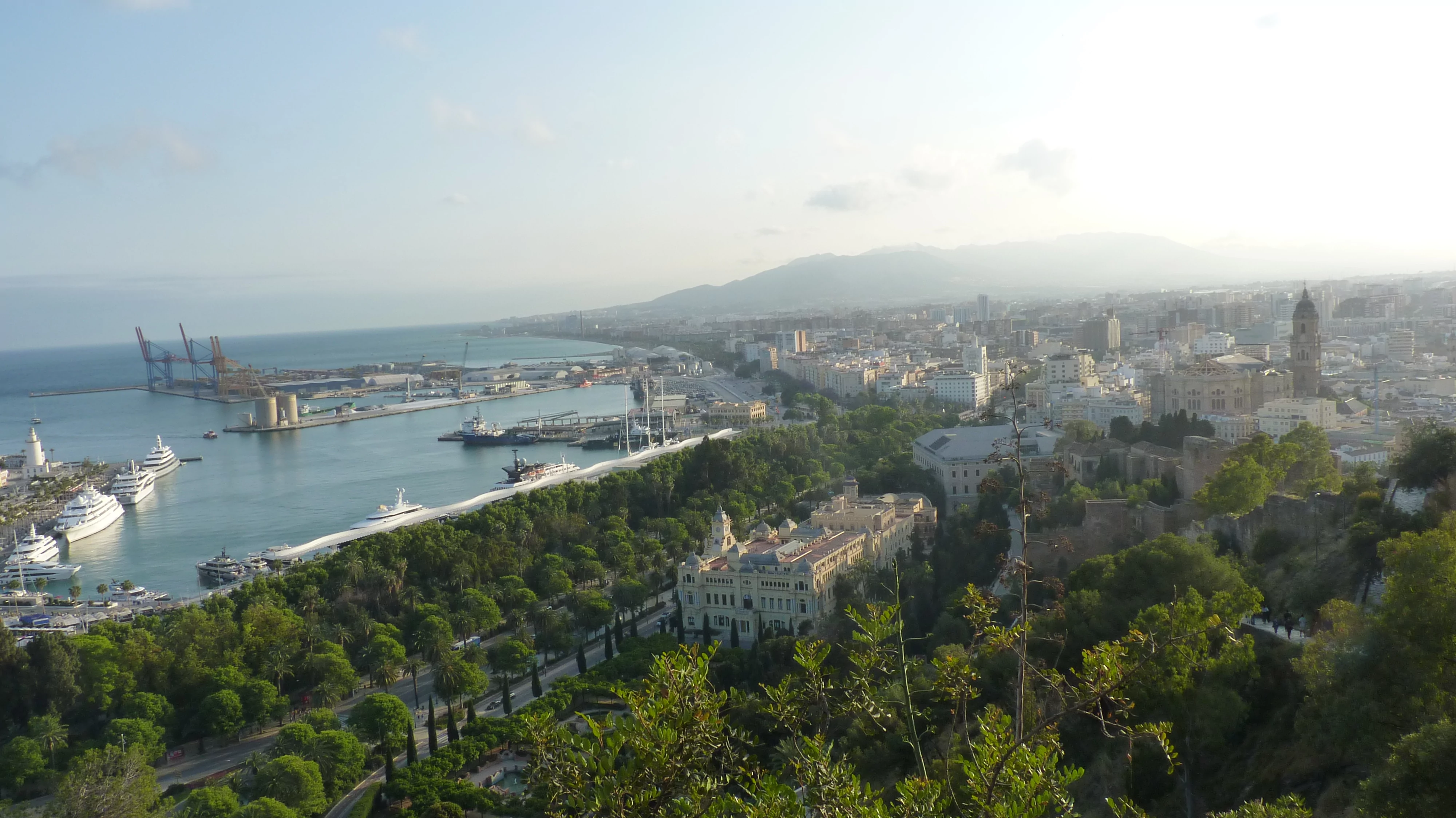
In spring 2026, from mid-April to mid-May, my wife and I stayed in Andalusia — a destination that had long been at the top of our list. The reason is the region’s rich history and pleasant weather with plenty of sun. This trip to Andalusia was not a classic “break from work”; it was a chance to live in the region for several weeks and soak up the atmosphere. I had to work remotely six days, but the rest of the time I was free to explore museums, beaches and day trips to other towns. Andalusia is Spain’s largest autonomous community, and our base on this trip was Malaga. From there we used different kinds of transport to visit other places and cities. This blog focuses on Malaga, where we rented a flat and spent most of our time.
TRIP PREPARATION
How to get there from BiH
For a long time I had been thinking about visiting Andalusia, tracking prices and routes, but I always ended up choosing other destinations that suited us better at the time. The idea of a longer stay came up a few months ago, and after discussing it with my wife we decided to go. We agreed it was best to settle in one place and then make day trips to other cities. We chose Malaga for several reasons. First, it has a well-connected airport with the rest of Europe and a rail station linked to the rest of Spain. The city is large and varied enough, it sits on the sea, and it is somewhat cheaper than alternatives such as Seville or Granada.
From Bosnia we flew via Croatia’s capital Zagreb with Ryanair, and we bought return tickets through their mobile app. We also looked at two options from Sarajevo. One was to connect in Bergamo near Milan and fly from there to Malaga; the other was a direct flight from Sarajevo to Girona, then the train to Malaga with a possible overnight stop in Madrid. In the end the first option was the simplest and cheapest.
After landing we took an Uber from the airport to the flat via the app; the fare was about 15 euros. The best option in general is bus line A to the centre, which costs 4 euros and stops in front of the terminal. We arrived late after midnight when that bus was not running, but we used it on the way back.
Malaga in general
Malaga is a city in southern Spain on the Mediterranean coast. It is the capital of the province of the same name and the second largest city in Andalusia after Seville. It belongs to the group of coastal towns in Costa del Sol, stretching from Malaga province to Gibraltar. On one side it faces the sea; on the other it is ringed by the Montes de Malaga hills. The climate is Mediterranean; during our stay daytime temperatures were mostly between 20 and 25 °C, and lows did not drop below 10 °C. Spring is the best time to visit before the peak summer heat. The weather served us well, except for a few showers in the last few days.
Malaga’s history runs from ancient settlements (Phoenicians, then Romans — remains of the Roman theatre are still in the centre) through Islamic Andalusia, when the city was an important port. It fell a few years before the fall of Granada in 1492, which marks the end of the Reconquista; it then became part of Castile and later grew as a Mediterranean port and trading centre. In the 20th century it went through civil war and the Franco era, and from the second half of the century it became a tourist and cultural hub.
Accommodation, public transport and language
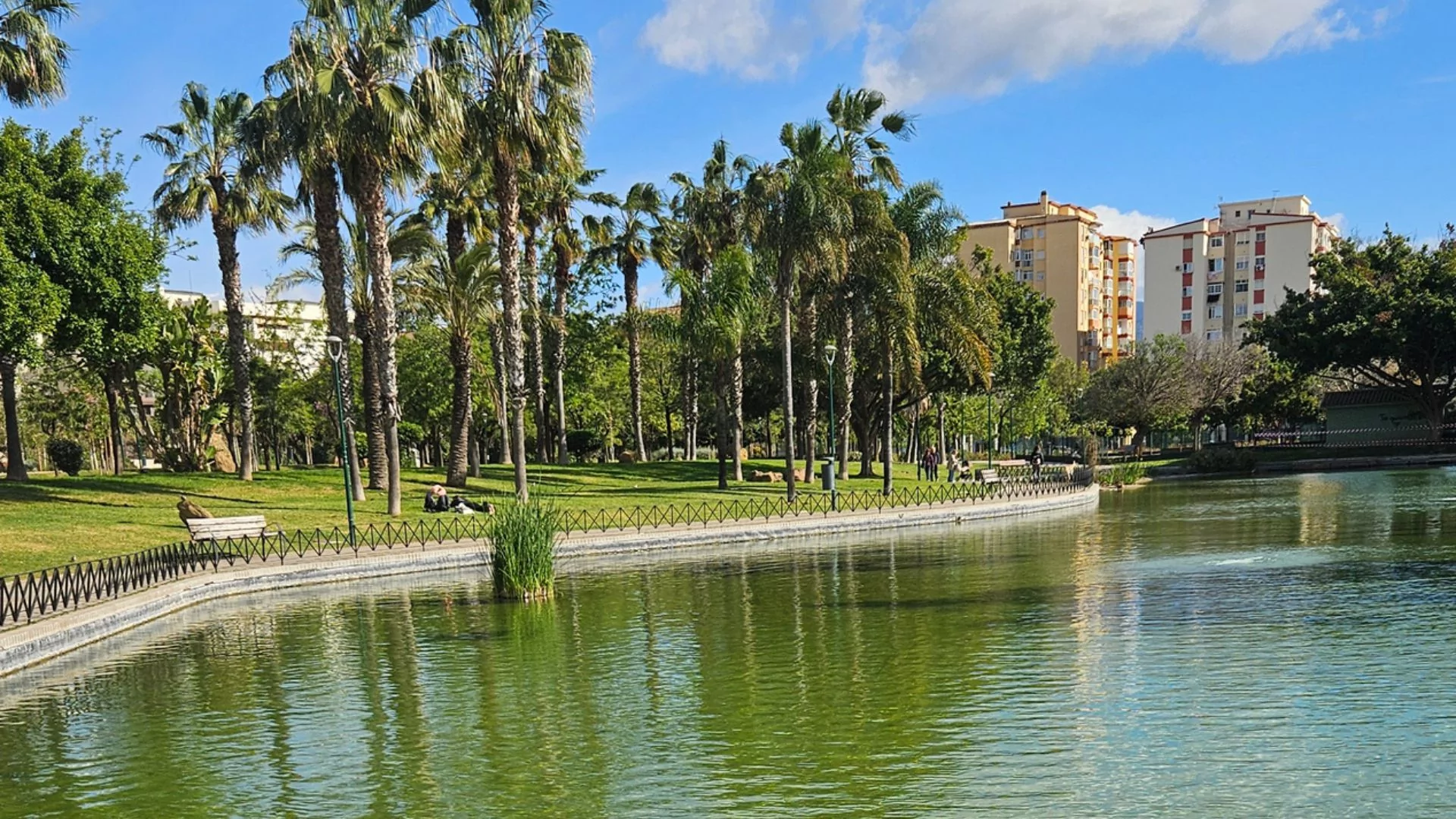
We were looking for a flat for a longer stay, so location mattered. The cheapest option is the resort town Torremolinos, about 15 km from the centre and the main summer destination. But we would have depended too much on transport just to reach the city, let alone other places. Malaga’s historic centre is fine for a short stay, but it is crowded and accommodation is pricier. Another issue is that many listed apartments share rooms. In the end we found a one-bedroom flat on Airbnb in Huelin, three kilometres west of the centre, with the main railway station even closer. Huelin is well kept, pleasant to live in, and you feel more of a local identity. A park and beach with a promenade are only minutes from our flat. Right next to the flat was a bus stop with lines to the centre and other parts of the city. The city bus network covered almost everything we needed; a single ride cost 1.40 euros. There is also a Metro, but we did not use it. Maria Zambrano is the main hub in this part of Spain for other cities, combining rail and bus stations.
As for Spanish, it is always worth learning a few key words and phrases. Tourist spots often work in English, but a little off the beaten path people mostly speak Spanish only. We quickly learned that efectivo means cash, con tarjeta card payment, and ¿puedo pagar? — “can I pay?”. I was convinced the verb was pueGo instead of puedo, and I used that almost to the end; nobody minded. Only near the end, talking with my wife, did we realise I had been using the wrong word. In shops they often ask if you need a bolsa — a plastic bag. Overall the impression is that people are happy to speak their language even when they see you are a foreigner who knows a few words, unlike Germany or France where they switch to English immediately.
CITY CENTRE
From Huelin to the centre we usually walked past the main station and on to the Guadalmedina river, dry for most of the year with only its bed visible. Crossing the river marks the start of the centre, with historic elements and the modern part with cafés and the port. When needed we also took city buses 1, 3 or 5.
Historic centre
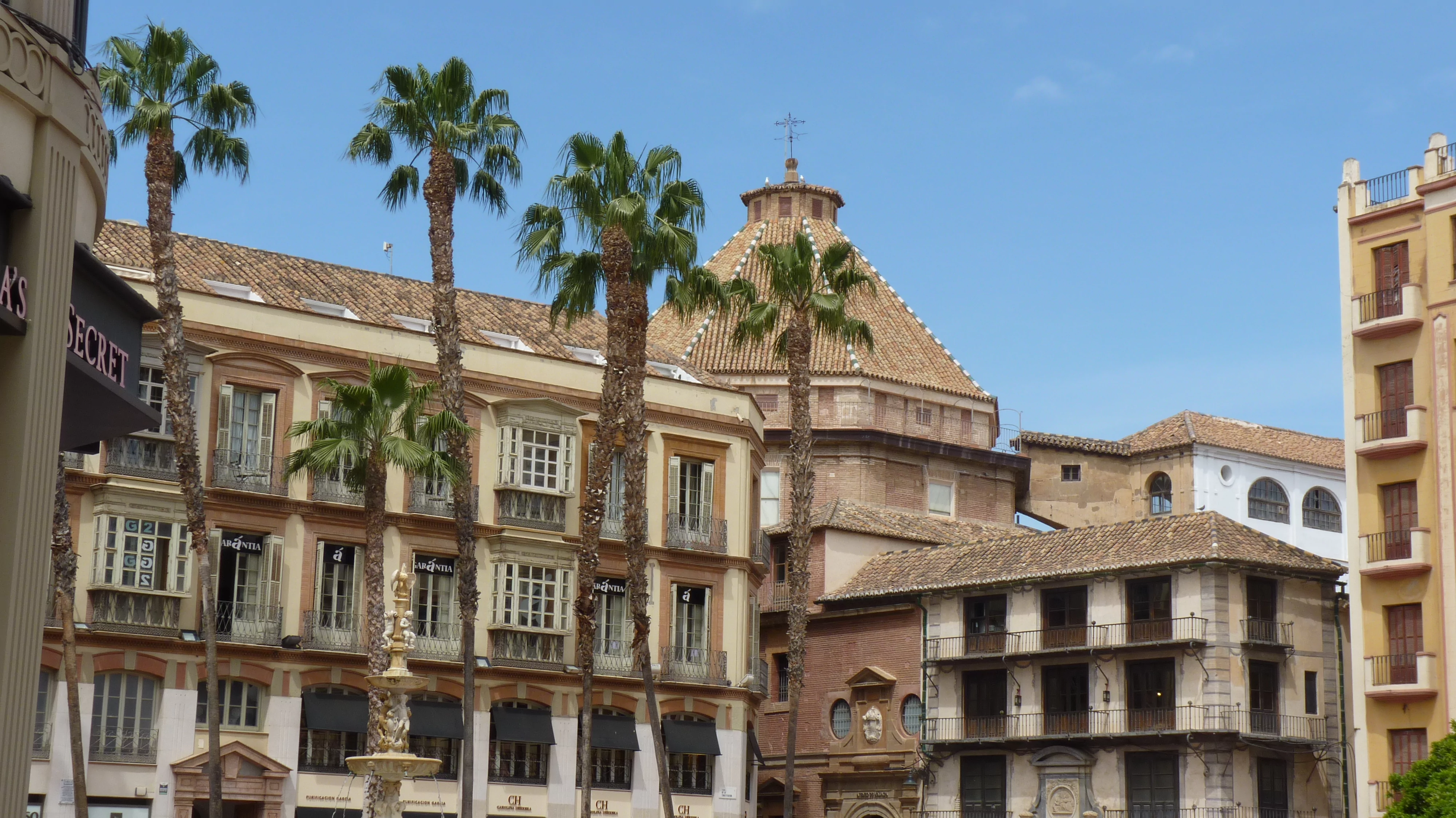
Centro Historico is a network of narrow streets, squares, restaurants and historic buildings linking the best-known parts of the centre. It is the main tourist area; the atmosphere is lively all day, especially in pedestrian streets full of cafés, tapas bars and small shops.
Right after crossing the river is Mercado de Atarazanas, the traditional city market known for seafood, fruit, olives and local products. Nearby is the cathedral (Catedral de la Encarnación), one of the city’s most recognisable buildings, around which the main pedestrian streets and squares spread.
Calle Marques de Larios stands out — a wide elegant street with shops and restaurants linking the centre to the port and seafront. Beyond it is Plaza de la Constitucion, the historic centre’s main square, almost always busy. Calle Granada is very lively, known for tapas bars and evening atmosphere, while Plaza de la Merced feels more relaxed and local, with many cafés and Picasso’s birthplace.
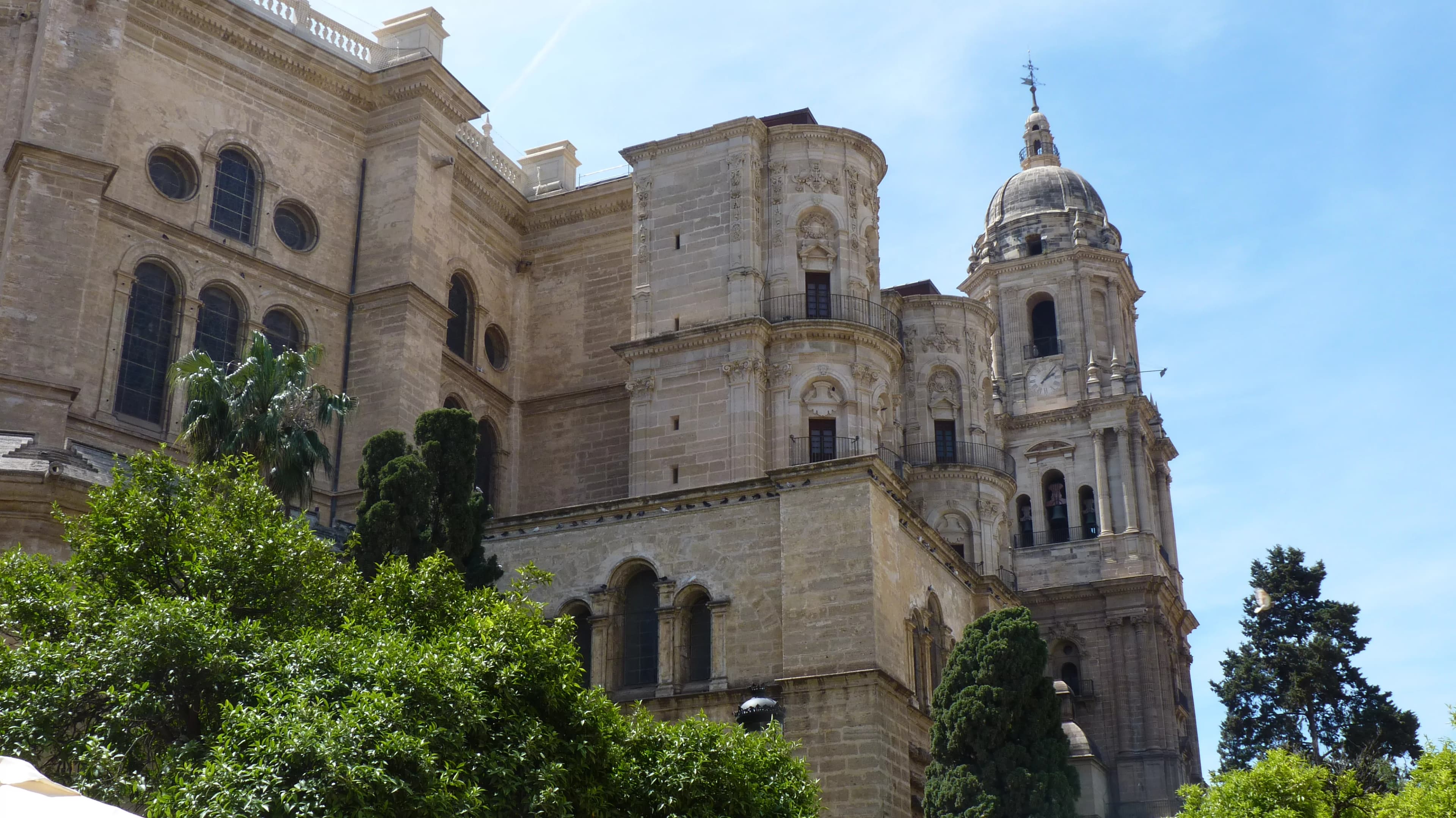
Cathedral in Malaga
Alcazaba and Gibralfaro
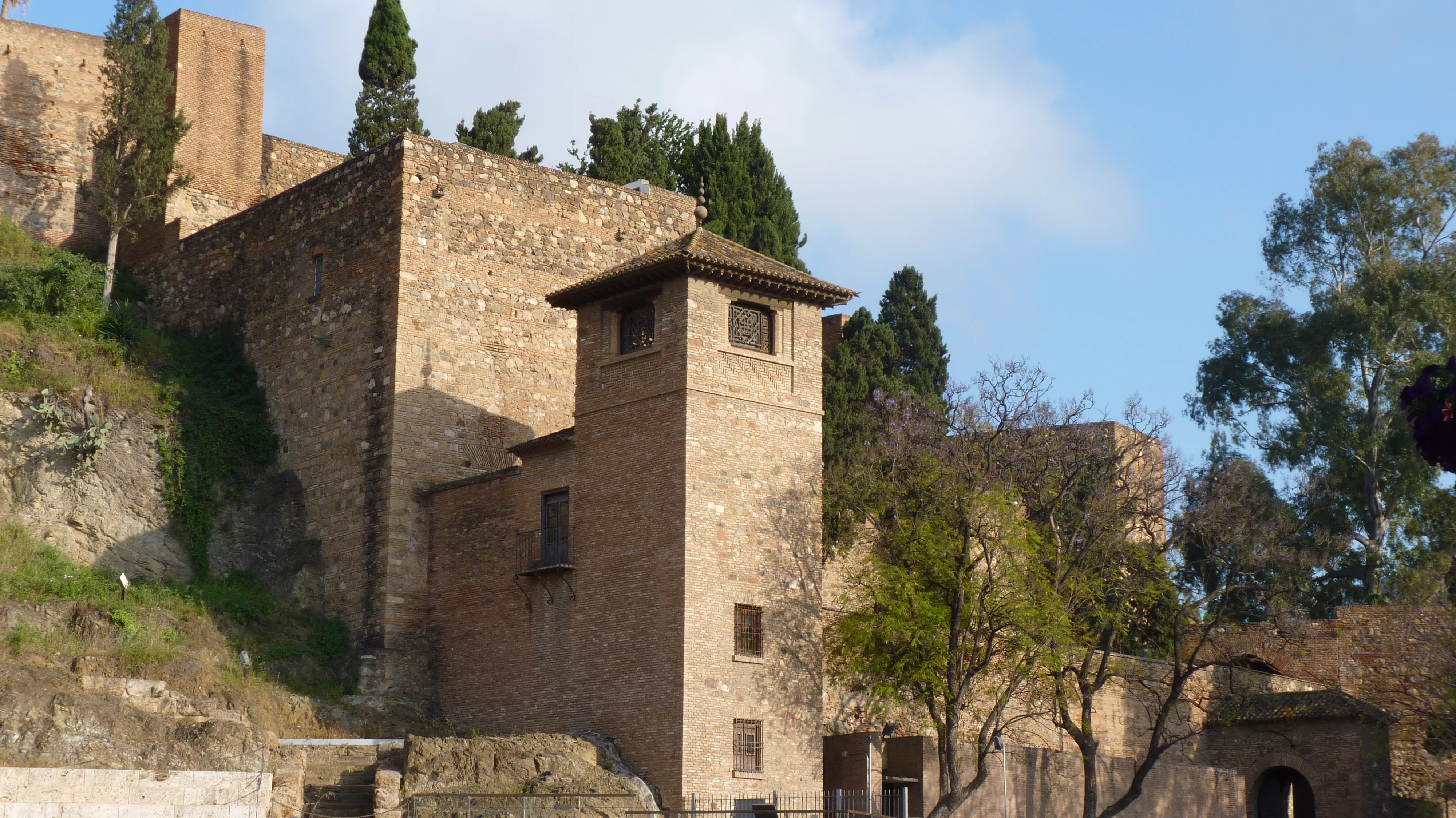
Above the old town on the hill stand Alcazaba and Gibralfaro, among Malaga’s main symbols. The Alcazaba is a fortress from Islamic Andalusia — essentially a walled “kasbah” with walls, courtyards and gardens. In that period they went through various layouts and eventually belonged to the Emirate of Granada, the last Islamic state in western Europe ruled by the Nasrid dynasty. At the foot of the Alcazaba are remains of the Roman theatre (Teatro Romano). Nearby is the bullring, today a tourist attraction but also a reminder of a tradition still present in local culture.
Beside the Alcazaba, steps lead up to Gibralfaro. On our first visit we bought a combined ticket for the Alcazaba and Gibralfaro for 10 euros; afterwards we climbed the free stairs several more times to enjoy the views and sunsets.
Gibralfaro is the fortress on top of the hill of the same name, with views over the port and city. Besides the views it has well-kept gardens; walking the fortress walls is especially pleasant. Inside there is also a café in the shade for a break after a lot of climbing.
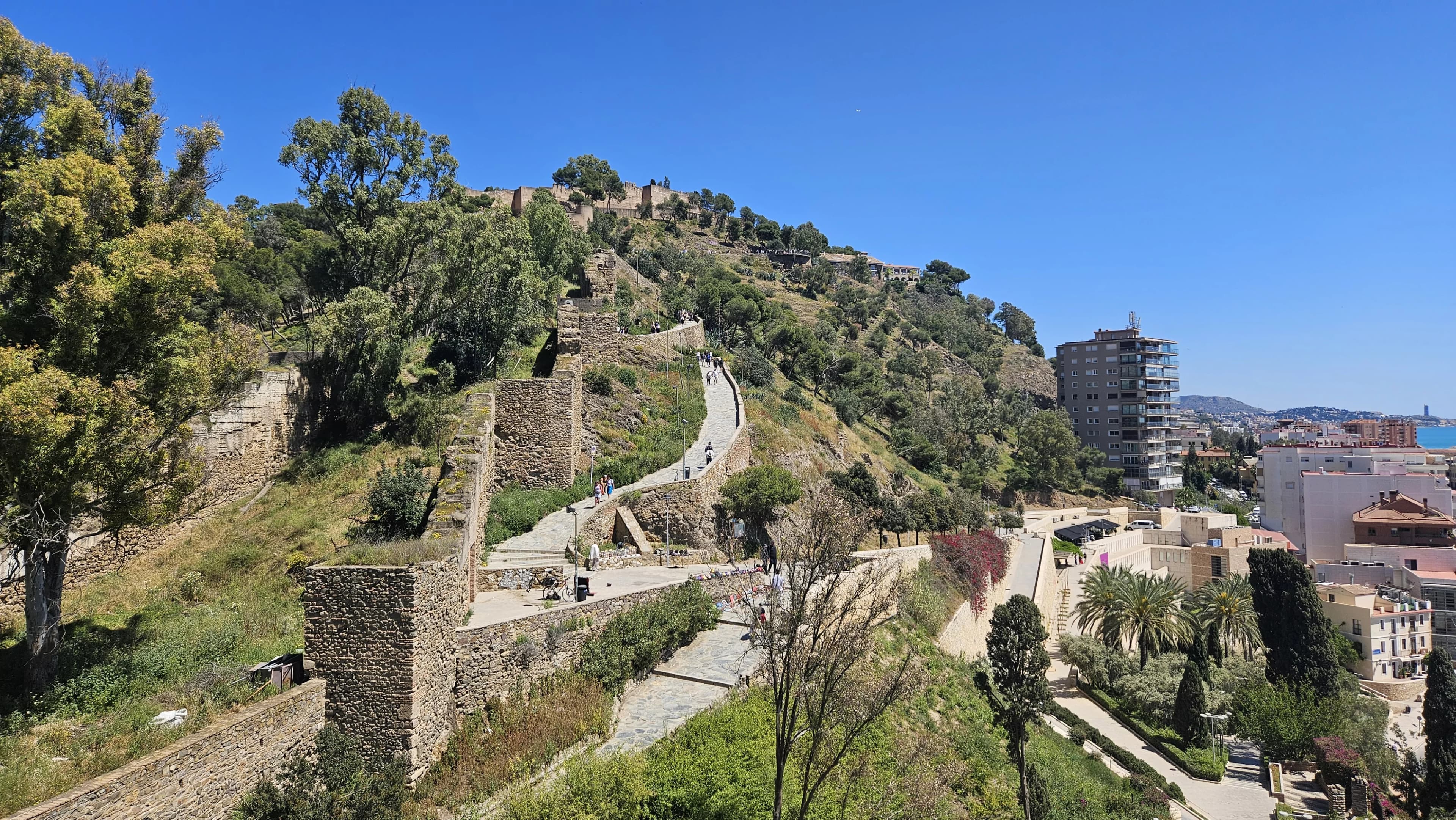
Steps from the Alcazaba towards Gibralfaro
Modern centre: Soho and the port
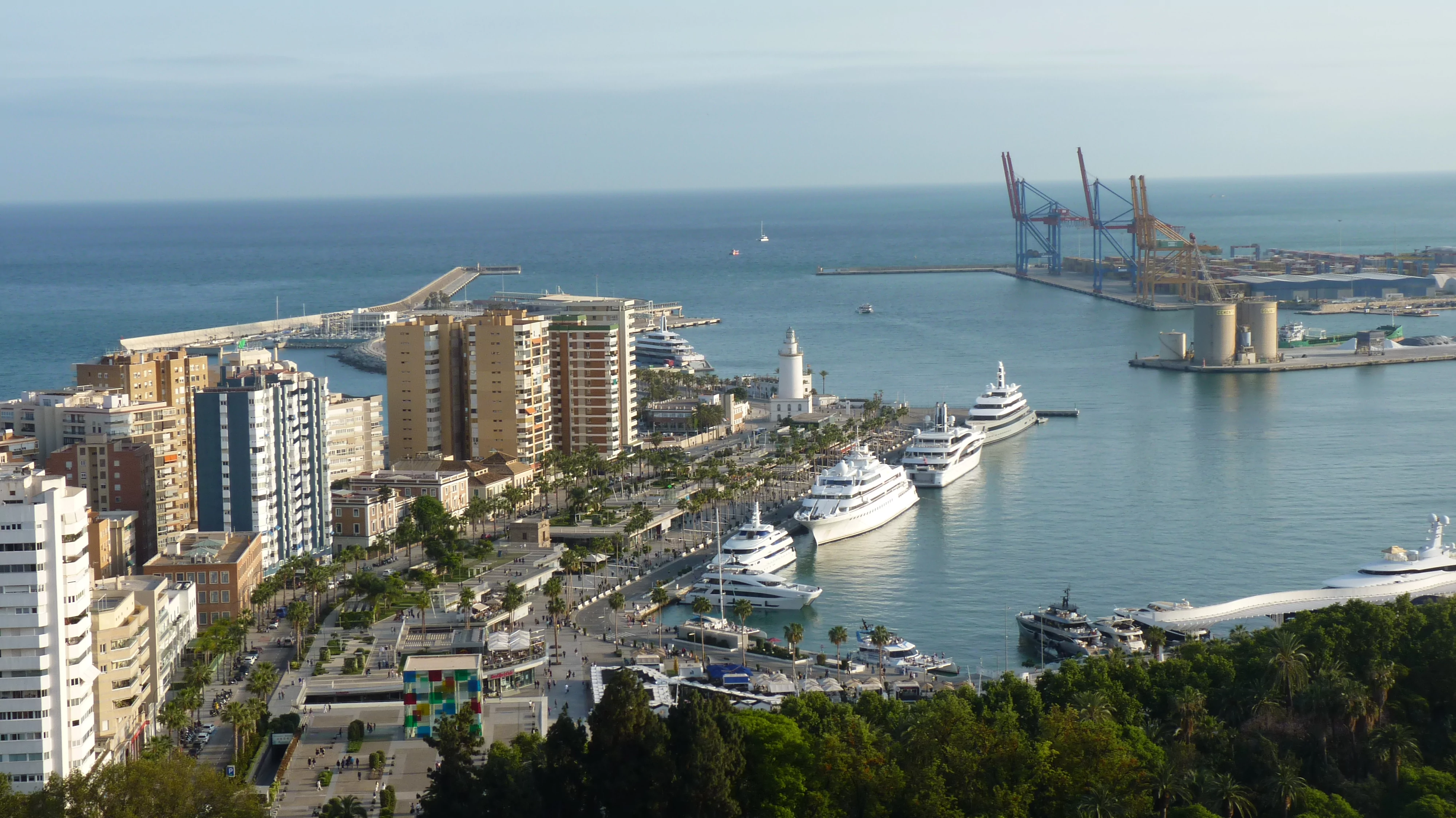
From the Guadalmedina, wide Alameda Principal runs alongside Paseo del Parque — a promenade through Parque de Malaga, a green belt between the historic core and the modern city. Behind the park is the old town of narrow streets; in front begin office buildings and access to the port.
The modern area includes Soho — street art on walls, smaller cafés and galleries. Towards the sea runs Muelle Uno, the port and promenade with restaurants and open-air clothing and souvenir stalls. There stands the colourful Centro Pompidou pavilion — a branch of the Paris museum of modern art, recognisable by its glass cubic form in red and blue. Much of the promenade is covered by modern structures that provide shade and make walking more pleasant.
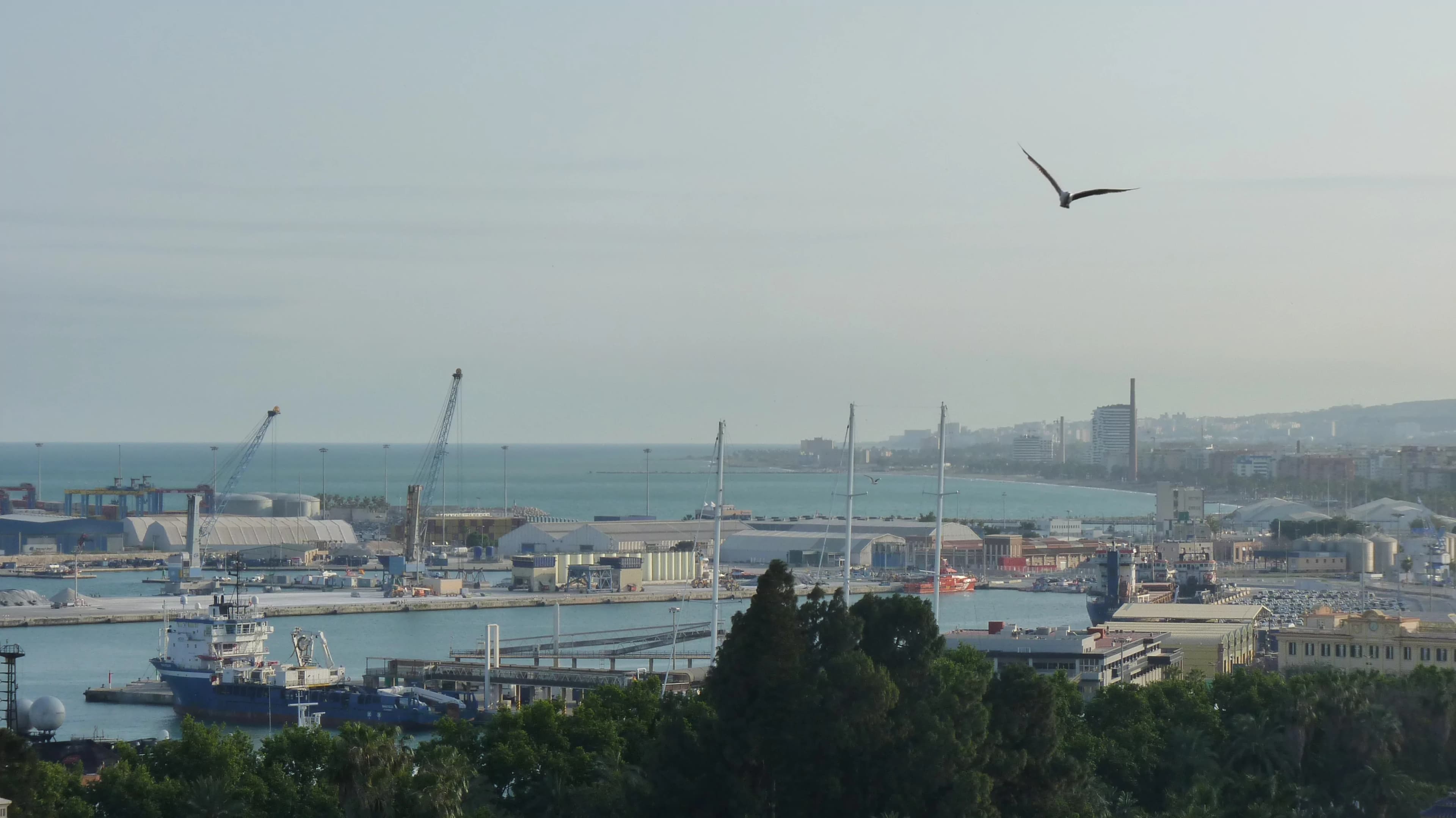
View of the port and sea
BEACHES
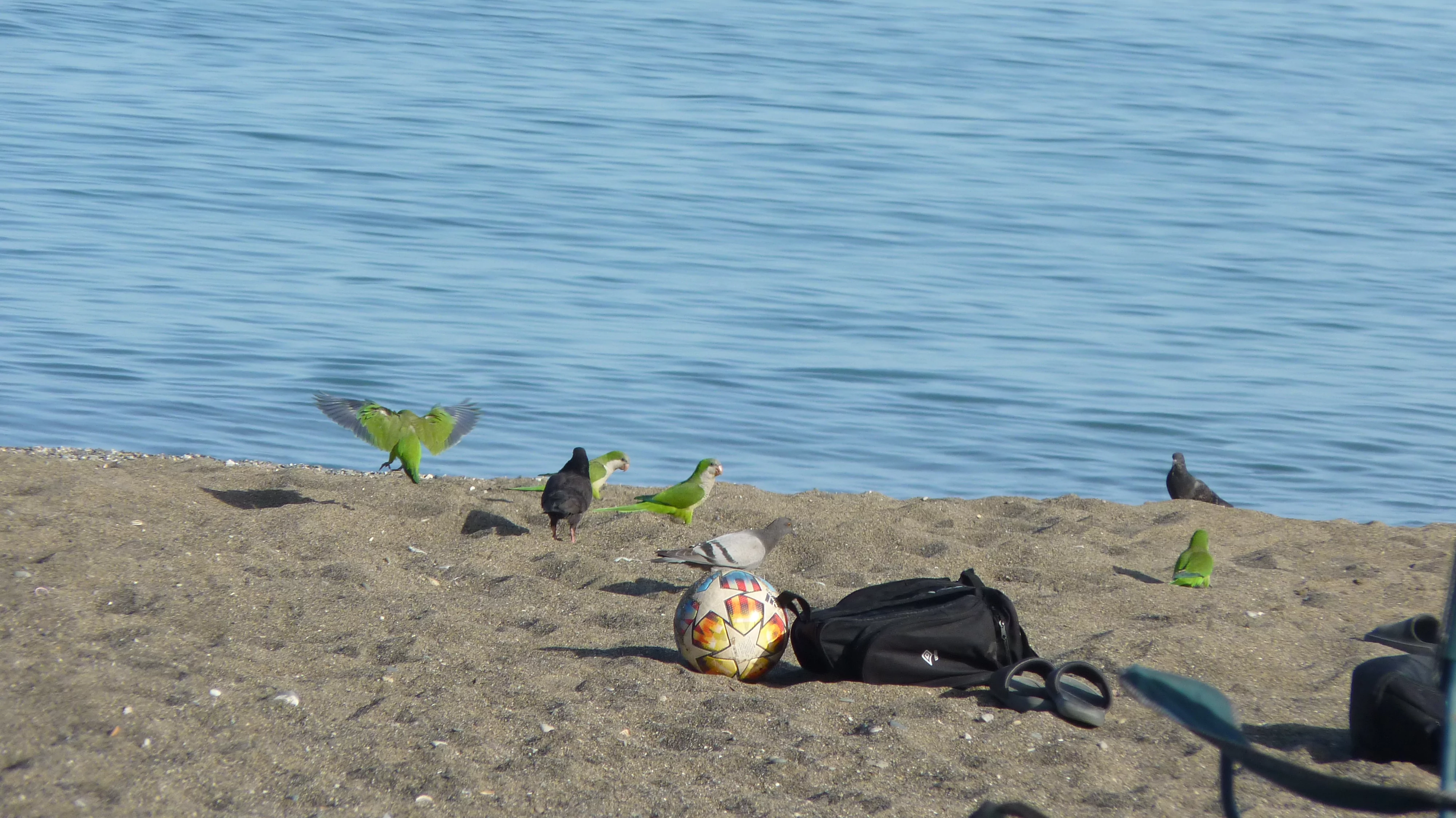
Along Malaga’s coast the beaches are sandy and mostly linked by a long promenade. Beyond the new port (Muelle Uno) continues the city beach Malagueta, closest to the centre. East of Malagueta is Pedregalejo with its own beach. Once we walked both beaches and ended in El Palo, which in some ways reminds me of Huelin for its local feel. On the walk we saw work on restaurants and cafés clearly preparing for the peak season. We returned on bus 3, which stops by our flat — another sign of how well Malaga is connected by public transport.
Between Huelin and the centre, the coast has an industrial port area. There is a promenade and cycle path; the walk is pleasant, but it is a working port without a beach and we passed that stretch less often.
Huelin has its own beach stretching west, where we spent most of our beach time. In this spring period the beaches were fairly busy, but fewer people were swimming than in summer. Most were relaxing, sunbathing or reading; some even worked on a laptop on a towel. Along the shore there are volleyball nets, usually occupied. A lot of small-sided football is played, and the promenade is full of runners and walkers. We played badminton a few times — fun but tricky when the wind picked up.
On every beach, including Huelin, there is outdoor exercise equipment. We joked that one piece was for “cable winding”. It is usually at the start of the beach for warming up before a run along the coast. We also often saw an unusual green bird, a monk parakeet, around the city and especially on the beaches.
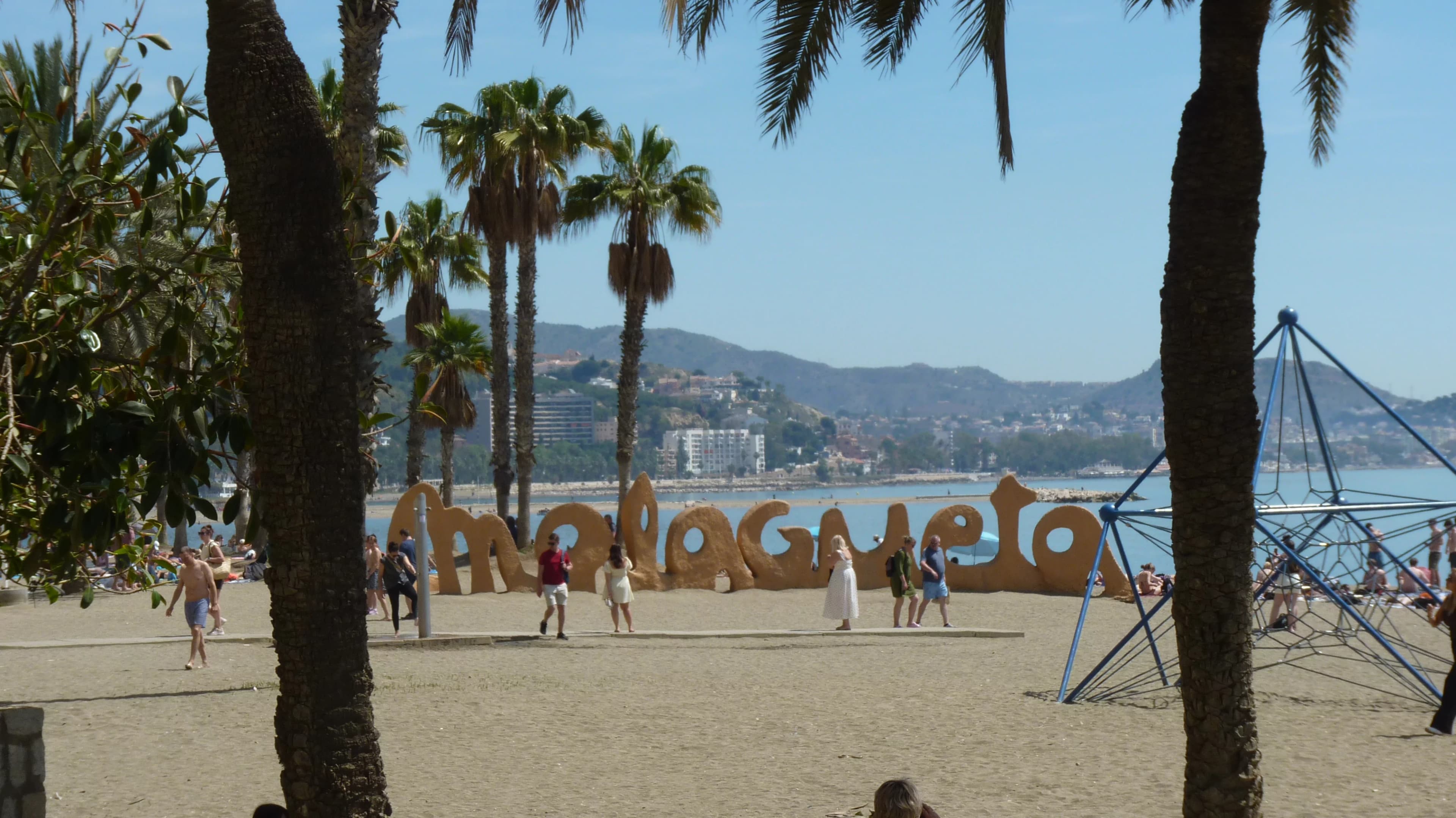
Malagueta beach
MUSEUMS
Malaga has many museums and galleries; the best known are Museo Picasso and Museo de Malaga, which we visited. We can also mention the Pompidou centre in the new port (we did not go inside), the Carmen Thyssen art museum in the centre, and Picasso’s birthplace Casa Natal de Picasso.
Museo Picasso
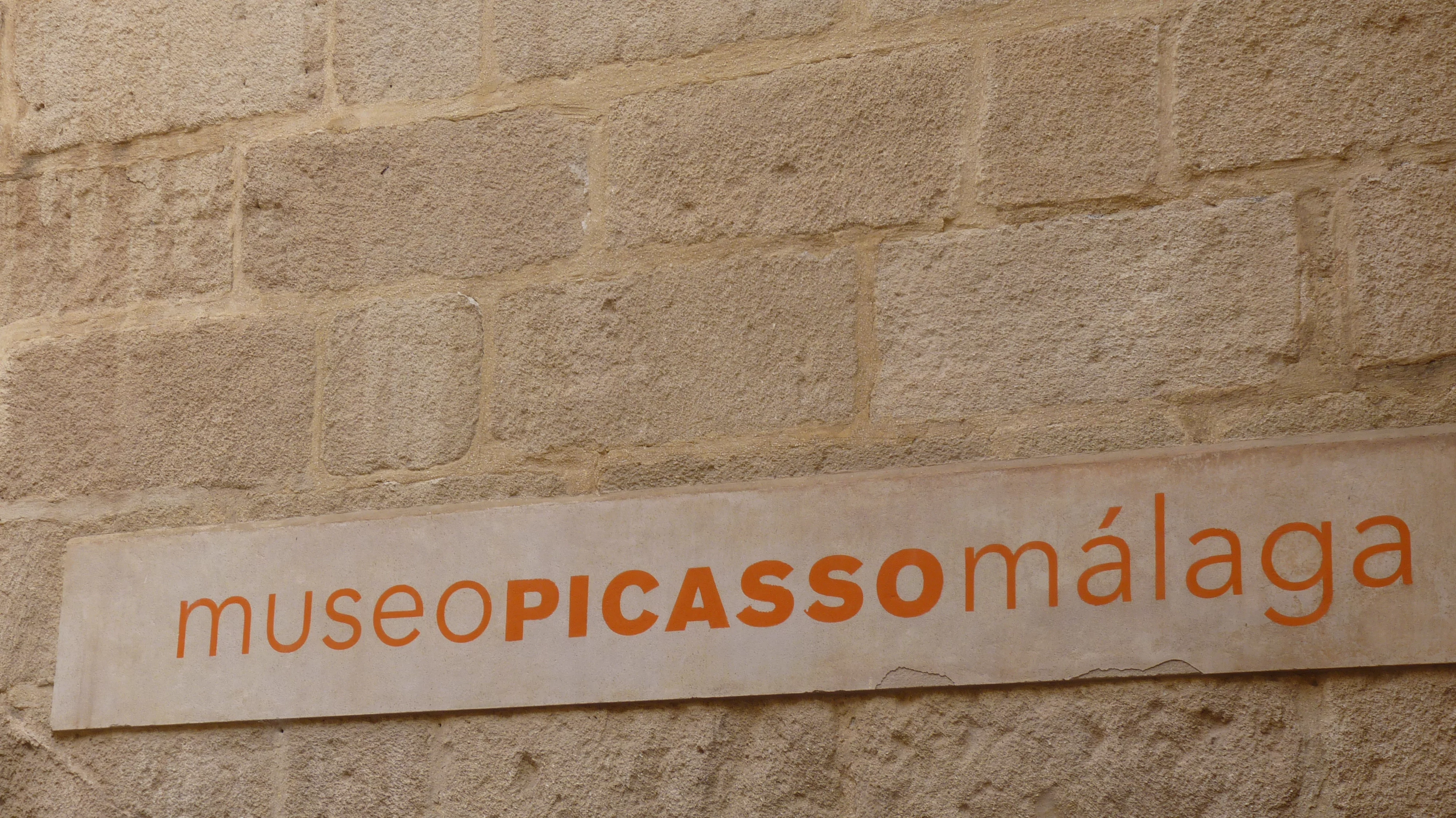
As the birthplace of Pablo Picasso, it is natural that Malaga has a museum dedicated to one of the 20th century’s most famous artists. Museo Picasso is in the historic centre, near the cathedral and Roman theatre; his birthplace, Casa Natal de Picasso, is on Plaza de la Merced.
Opening hours are 10:00 to 19:00; admission is 13 euros. However, Sunday visits in the last two hours are free, which we used. A queue starts forming around 16:30 and can stretch almost to the cathedral. After standing in line we waited nearly an hour to get in. That was fine — we had time, and the temperature was pleasant.
The museum follows Picasso’s life chronologically — his development and phases from earlier, more realistic work to the period for which he is best known as a pioneer of cubism. You can also follow the cities and periods in which he worked, from Malaga and Barcelona to Paris and the Côte d’Azur.
Although his moral character and private life are debatable, his work teaches a lot about creativity, discipline and how ideas develop. Especially interesting were his sketchbooks and studies showing how he moved from classical, realistic drawing to simplified forms and cubism. That process of experimentation can be linked to other fields, not only art. The museum also shows how Picasso did not limit himself to painting on canvas: sculpture, ceramics, printmaking, stage design, even poetry. The overall impression is that he did not wait for perfection before starting — he developed style and quality through constant work and attempts.
The Picasso museum often runs workshops on different techniques. My wife used our longer stay to attend a ceramics workshop. It was entirely in Spanish, so part of the experience was getting by with basic words, the instructor’s gestures and watching other participants. In her view the group included locals and foreigners who had moved to Malaga and use such events to improve their Spanish. The workshop ran three days, three hours each; the full price was 45 euros.
The first day began with a short introduction and a tour of part of the museum devoted to Picasso’s ceramics in his later period. The guide explained what inspired him then — a return to Mediterranean roots, simpler forms, animals and motifs such as bullfights, common in his ceramic work.
Then the instructor gave a short presentation about himself and his method, and everyone received clay from Spain. Each person had to prepare a reference to work from; the instructor gave individual advice on shape and proportions. My wife decided to make a vase with a floral motif.
The work used a hand technique often called “churros” — without a pottery wheel. Pieces of clay were rolled by hand into long churro-like shapes, laid in a circle and joined to build height and form. After the initial shaping everyone refined their pieces; at the end of the day the clay was wrapped in bags so it would not dry too fast.
On the second day shaping and finishing continued. Unfinished work was lightly sprayed and returned to bags to stay soft; finished pieces were left out to dry slowly.
The third day was for final details — shaping, dusting and small corrections before painting. The instructor showed how to prepare paints and suggested combinations for the effect after firing. It was striking how different the pieces were: some had a simple vase shape but very detailed decoration; others had complex shapes with simpler design and colour.
After the final painting the work was left to dry; glazing and firing come in the following weeks. Only then does the ceramic get its true colour and shine — at this stage it still looks matte and somewhat washed out. Since we returned to Bosnia and will not be there when the process finishes, we exchanged contacts to try to arrange shipping.
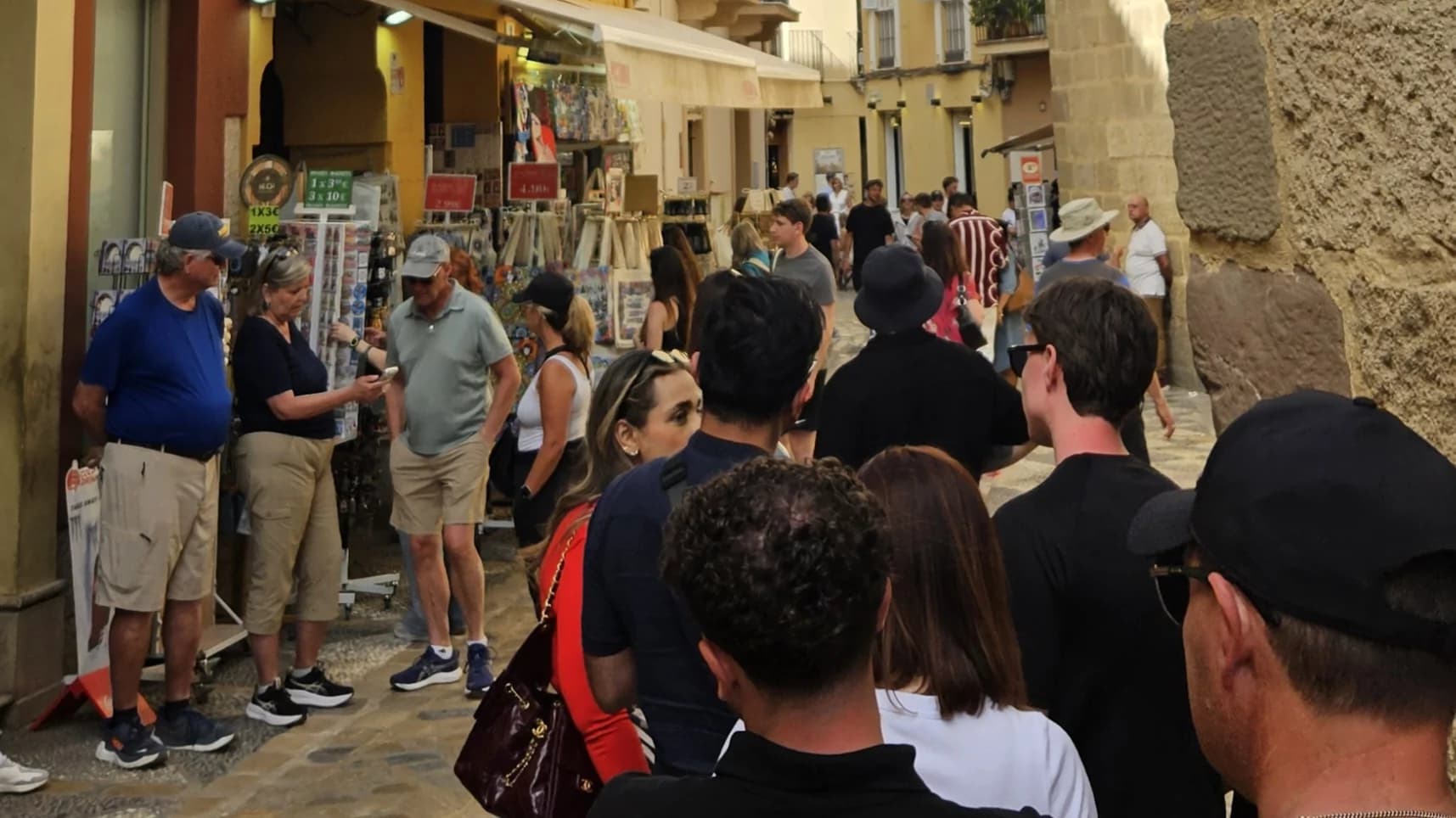
Queue outside the Picasso museum
Museo de Malaga
Museo de Malaga is in the historic Palacio de la Aduana, next to the Alcazaba and Roman theatre in the centre, like the Picasso museum. It combines art and archaeology, giving a broader picture of the city and Andalusia across eras. The interior is spacious and elegant. Standard admission is 1.50 euros; for EU citizens entry is free.
The art section focuses on Malaga and Andalusia; through paintings you can follow how the city, coast and society changed. Much of the collection is from the 19th and early 20th centuries, when Malaga developed as an important Mediterranean trading and industrial city. Everyday life, the port, trade, the Mediterranean shore and Andalusian people appear often, so the museum also works as a visual story of the city’s development and identity.
The archaeology section covers several periods from the Palaeolithic through Phoenicians and Rome, Islamic Andalusia to the modern era. Objects, sculpture and pottery show how Malaga was shaped by different civilisations and cultures.
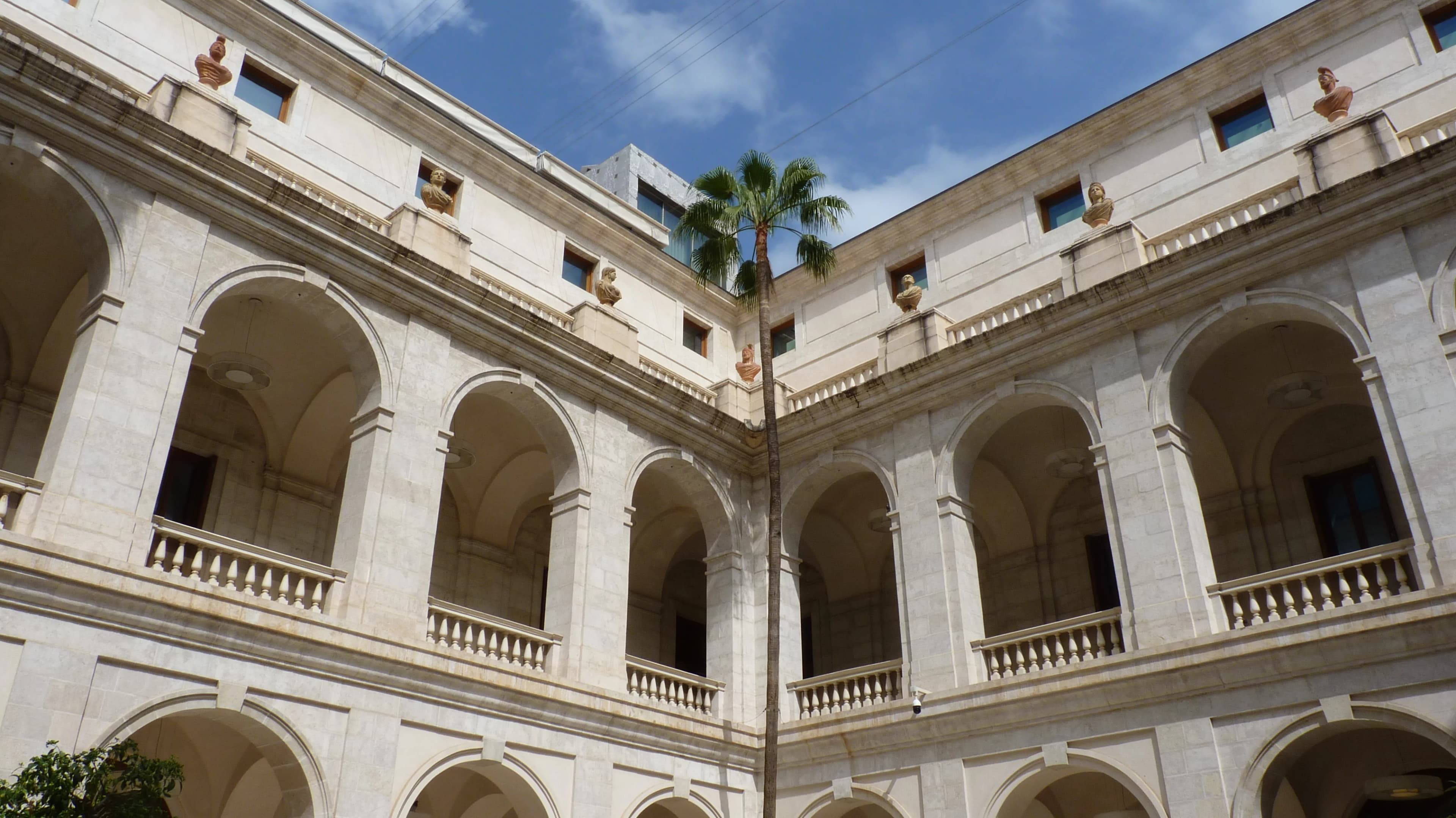
Interior of Museo de Malaga
FOOD AND MARKETS
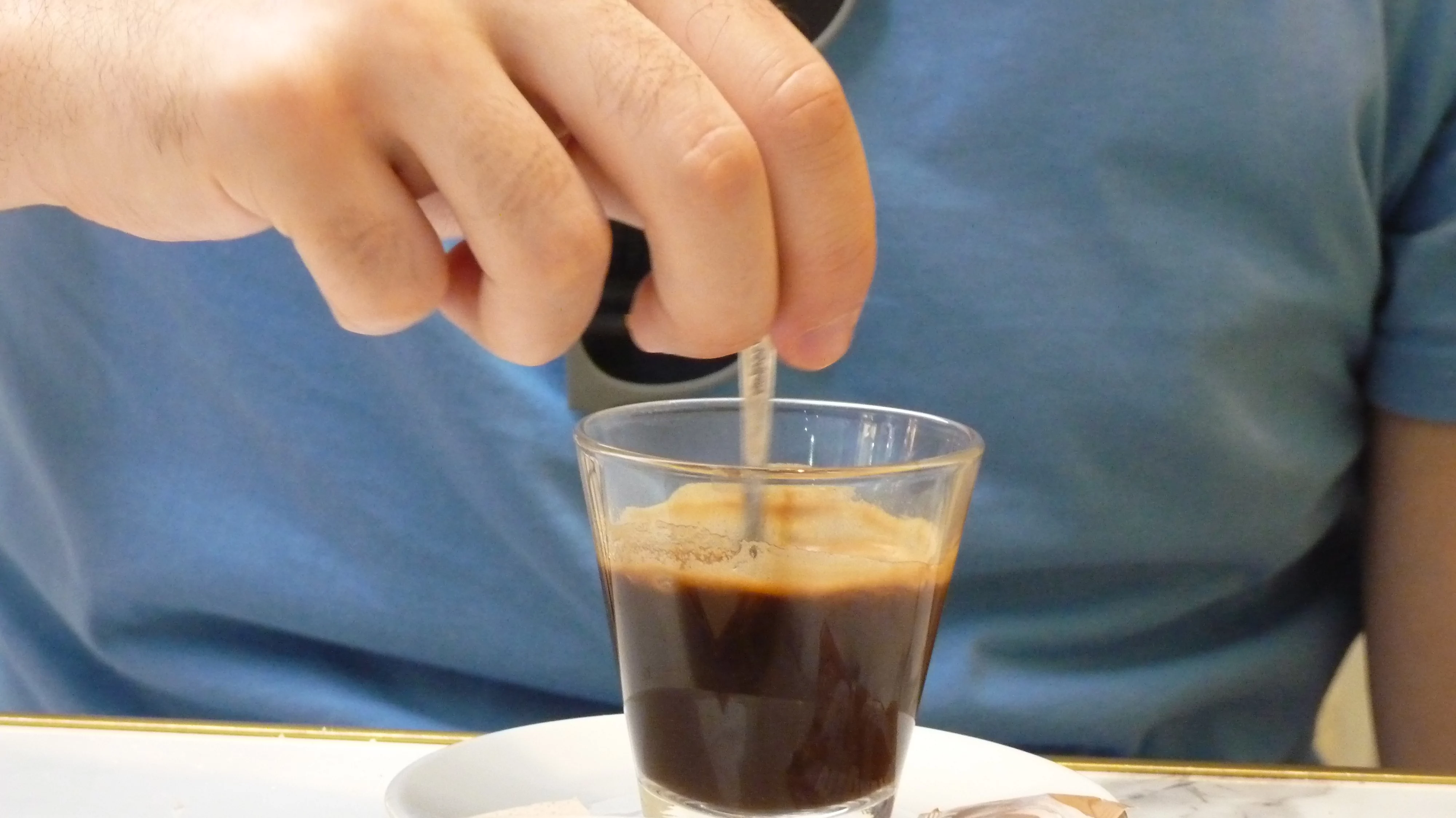
Besides exploring the city, daily shopping and food were part of life in Malaga. Mercado de Atarazanas, mentioned earlier, is probably the best place to discover local products — fresh fish, meat, fruit, vegetables and more. There we tried food by buying small bites or gifts. In cafés we mostly drank espresso (cafe solo) and coffee with milk (cafe con leche) at 1.40 euros.
Since we had a flat, most meals were at home, which proved very practical. Many basic products seemed affordable. Eggs, milk, bread, oil and pasta were mostly similar in price or even cheaper than in Sarajevo. We found halal butchers near the flat and bought beef and chicken once. For example, minced meat was about 12 euros per kilo.
We shopped most often at Spain’s best-known chain Mercadona and Supeco, the nearest to us. Malaga also has large chains like Lidl and Aldi. Big supermarkets are closed on Sunday, but the city has many small corner shops open every day, unlike Germany or France. Mercadona’s main own-brand producer of almost everything is Hacendado, also the cheapest. Among products we bought I can mention tinned sardines or tuna in olive oil (I had them for breakfast a few times) or a pack of 12 small ice creams for 3.40 euros. When we were out at lunchtime we usually had kebab for 5.50 euros or pizza for 8 euros.
El Corte Inglés is found all over Spain, including Malaga by the Guadalmedina; cross the bridge and you are practically in the historic centre. We were not much interested in shopping — generic brands — but it was useful for a short break or the toilet while touring. Just before it, above the main station on a roundabout, is Larios shopping centre, smaller; we went there most for Primark. There are also Asian shops in several places; we bought wasabi peanuts, which my wife likes.
Restaurants and seafood
Although we mostly ate at home, we tried seafood in restaurants several times — in Malaga it is cheaper and fresher than we are used to. It is especially affordable in local restaurants outside the centre, very close to us. In the centre or on the beach restaurants cost more. They are generally open 13:00–17:00 for lunch and from 20:00 until midnight, when Spaniards traditionally dine. Each time we went to a nearby restaurant we found online with excellent reviews. They barely speak English, but there is an English menu, so ordering was not a problem.
The first time a waiter who spoke some English had to bring the Spanish menu too so he could take the order more easily. On our second visit another waiter, noticing we were foreigners, said he would call a colleague who speaks English best. In the end the same waiter from the first visit came. They are very kind and service is excellent — a small amusing anecdote from the restaurant. The third time we were very hungry, knew what to order and had learned the Spanish names. Passing the restaurant we often saw crowds and queues, but we luckily avoided that, probably because we did not go on weekends. I especially liked squid and prawns; my wife liked salt cod. I tried octopus for the first time — highly rated reviews, but though I ate almost all of it, it is chewier and less tasty than squid for me. Seafood comes with lemon, and some dishes with a salad dressed with lemon and olive oil. As soon as you sit down they bring bread charged at 1.80 euros — say immediately if you will not eat it. These dinners cost between 25 and 35 euros. There are also chiringuito beach restaurant-bars typical of the coast; we did not visit them.
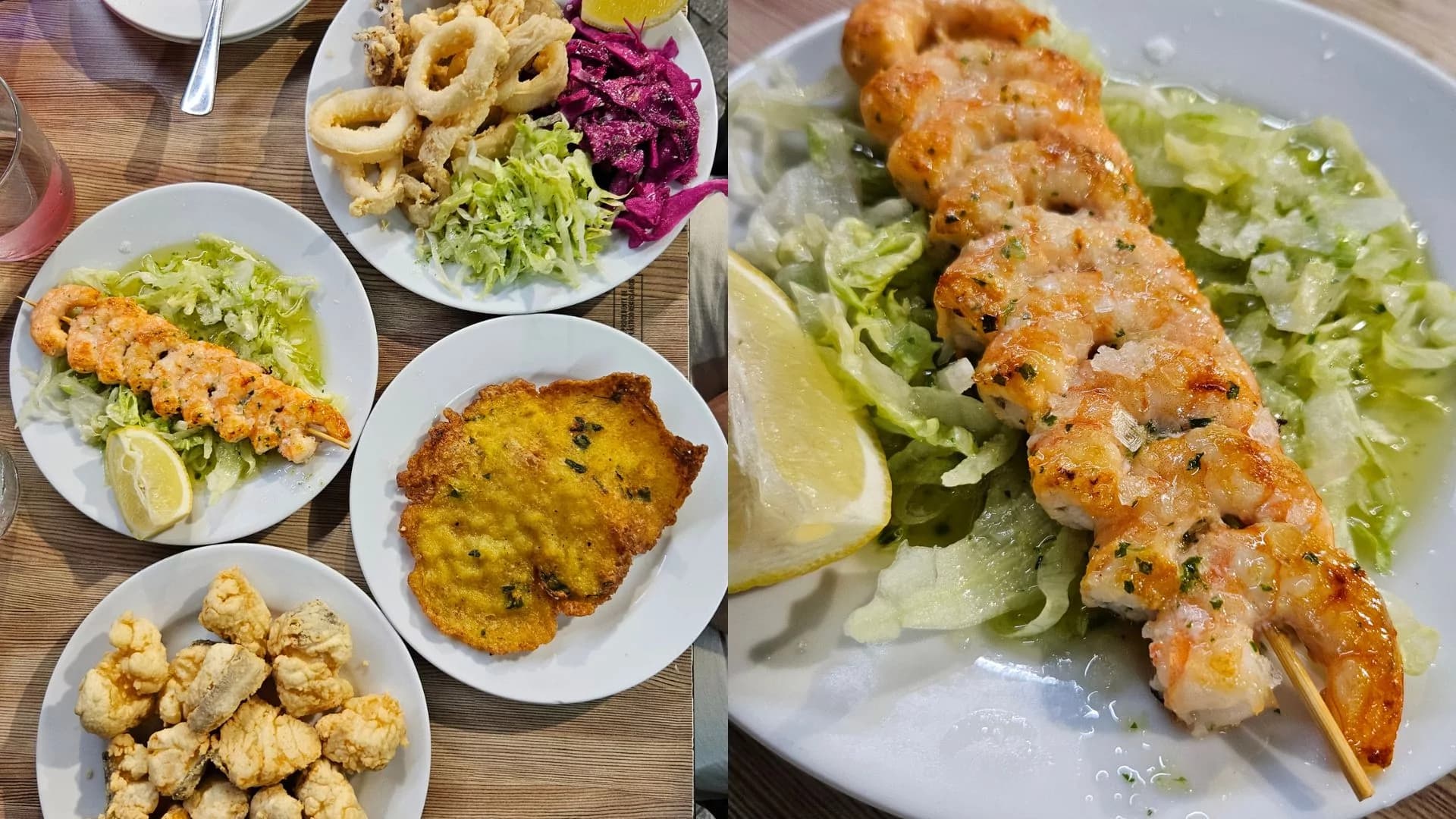
Salt cod, small salt-cod tortilla, squid and prawn skewers
Churros, turron, bocadillos and tapas
Besides seafood and local restaurants, we were interested in dishes and sweets found across Spain, deeply tied to the culture.
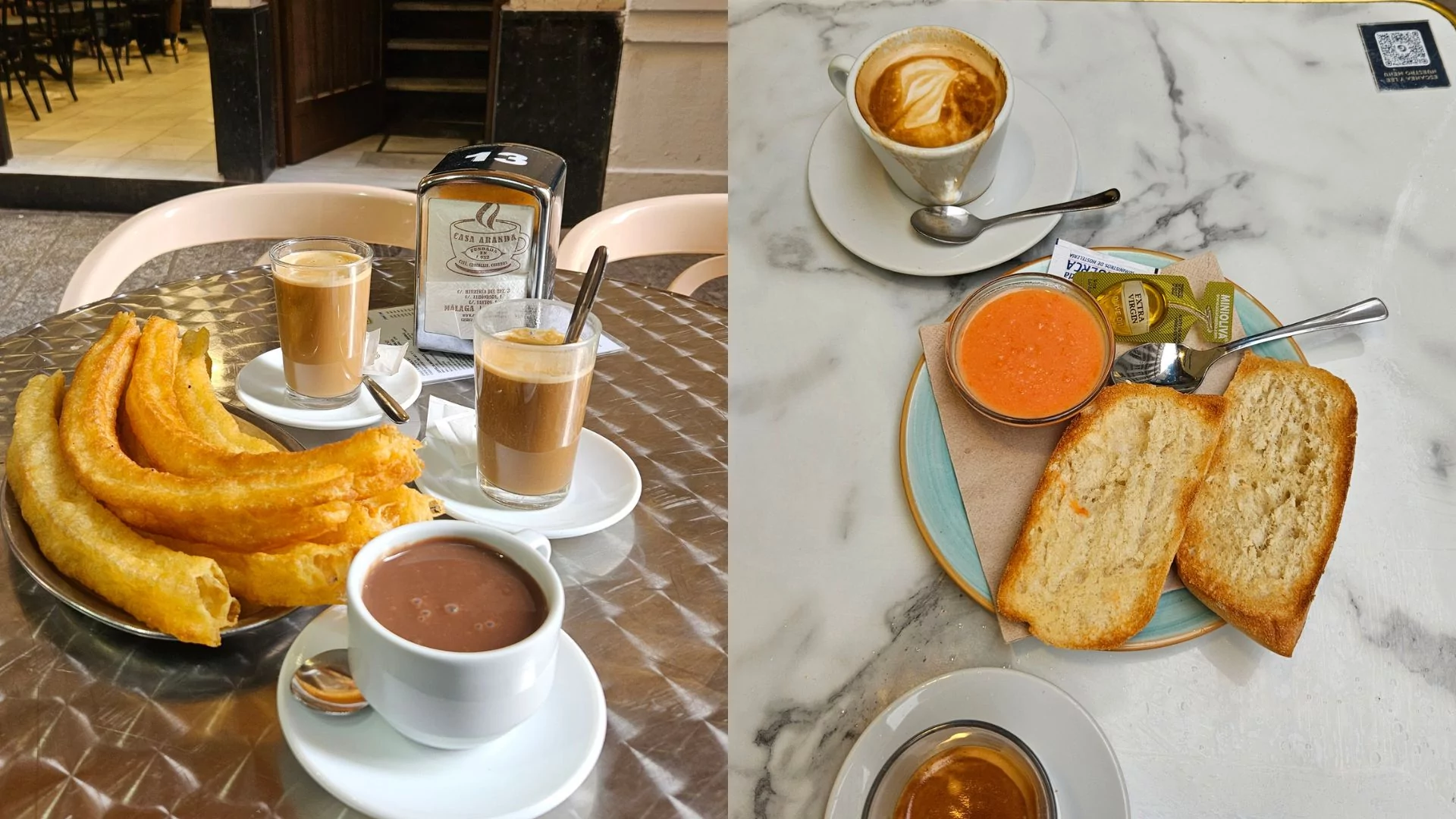
Churros are a sweet fried pastry usually eaten with hot chocolate. We had them several times and each time said we would not again because they sit heavy, but it is hard to resist. The main place for them in Malaga is Casa Aranda.
Turrón is a traditional Spanish sweet similar to nougat, most often with almonds but also chocolate, strawberry and other flavours. Easiest to find at Sabor a Espana, a chain across Spain. We tried several and often ate them with coffee; they also make nice gifts.
Bocadillo is the classic Spanish sandwich on baguette. The main filling is usually ham (jamón), which we do not eat, so I had it a few times with tuna or just cheese and tomato for about 4–5 euros.
Tapas are small dishes or snacks with drinks or as a combination of small meals — not one specific dish. They can be different olives or cheeses; we also tried patatas bravas, croquetas with salt cod, boquerones (fried anchovies) and pan/tostada con tomate. I especially like the last for its simplicity (toasted bread, grated tomato and olive oil), served in many cafés for about 2.50 euros. You can see an example on the image below on the right; churros with hot chocolate are on the left.
Flea markets and open-air markets
During our extended stay we visited flea markets — a chance to buy various goods more cheaply and feel local everyday life. In our neighbourhood Mercadillo de Huelin runs on Wednesdays and Saturdays. It has many stalls; my impression is they focus mostly on women’s clothing, so it was less interesting for me, but very busy. West of Huelin (away from the centre), by Victoria Kent metro station, is Malaga’s largest flea market, simply Mercadillo de Malaga. It is open Sundays from 9:00 to 14:30. About twenty minutes on foot from us; we started three Sundays with a visit. It reminds me of the market at Stup in Sarajevo — you can find almost anything. Mostly locals visit; it is crowded and you can spend hours. At the start there is a kiosk and covered tables where you can eat and escape the sun. Stalls sell clothing of all kinds, fruit, vegetables, tools, books, souvenirs, and there is also a car market. Fruit stood out as fresh and cheaper than in Bosnia. Strawberries were 2 euros per kilo, mango 2 to 3 euros, avocado 2 euros, cherries 3 to 4 euros, and you could get two kilos of oranges for one euro. The first Sunday I got carried away trying different olives and bought almost a kilo. I joked I would have to eat 30 a day to finish them before we left — I did not, but packed them nicely and brought them back to Bosnia. Below are a few images from the market atmosphere.
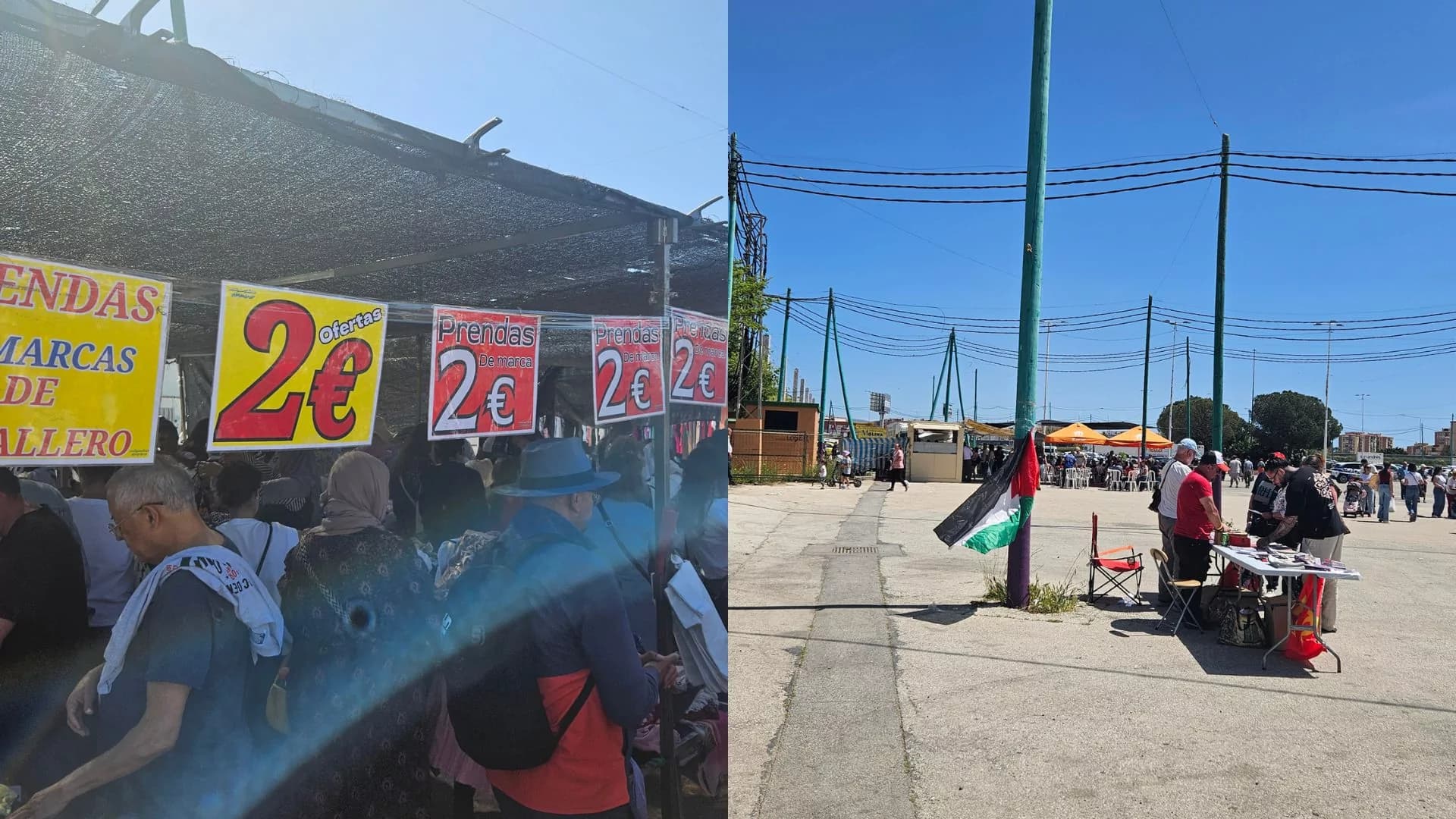
Mercadillo de Malaga — flea market
Olive oil
Olive oil (Sp. aceite de oliva) is a special story in Andalusia, the world’s largest producer of this oil. Travelling from Malaga to other towns in Andalusia you see endless olive groves. The olive tree fascinates me because it can live for hundreds, even over a thousand years, and has great nutritional value. It withstands heat, drought and rocky soil, so the olive is a symbol of the Mediterranean. Jaén is best known for oil production, with tens of millions of trees; then Cordoba, Granada and Seville, but Malaga also has good local producers. Well-known brands can be bought in any city or at the airport duty-free.
By production method, olive oil can be:
- Ordinary olive oil — when the label says only “olive oil” it is a blend of refined and virgin oil. Refined oil comes from weaker olives by chemical and thermal processing. It has no aroma or taste and is mixed with virgin oil for flavour and colour. Lower nutritional value, milder taste, cheaper.
- Virgin olive oil — obtained purely mechanically: olives are ground and oil separated by centrifuge or press. Often labelled cold-pressed because processing is at lower temperatures to preserve quality.
- Extra virgin olive oil — also mechanical, but from the healthiest olives processed quickly after harvest (within hours), often early harvest (cosecha temprana). Early olives yield less oil, so more olives per litre and higher price. An important classification parameter is free fatty acids: under 2% for virgin, under 0.8% for extra virgin. Premium oils can go down to 0.2%.
Oil can be from one olive variety or a blend. We most often saw:
- Arbequina — Mild, fruity oil with green apple, banana and fresh grass. Gentle pepperiness and softer taste; pairs well with avocado, salmon, yogurt, fruit or even ice cream.
- Hojiblanca — Fresher oil with tomato, grass and green leaf notes. Often in salads, with tuna and red meat, or simply for dipping bread.
- Picual — Intense, strong oil with pronounced herbal notes like freshly cut grass. Characteristic bitterness and pepperiness; excellent with salads, pasta, cheese, pizza and fish.
Virgin olive oil in supermarkets costs from 4.25 euros per litre; extra virgin ranges from 4.75 euros in supermarkets to around twenty euros per litre for premium oils in specialist shops. Price per litre rises in smaller bottles. If the variety is not listed, it is usually a blend. We bought different extra virgin oils in supermarkets and premium oils according to luggage space — larger bottles of one or half litre and smaller 250 ml, 100 ml, even 25 ml.
I tried all three with bread: full of flavour and aroma. Green apple stands out in Arbequina, tomato in Hojiblanca, and stronger intensity in Picual.
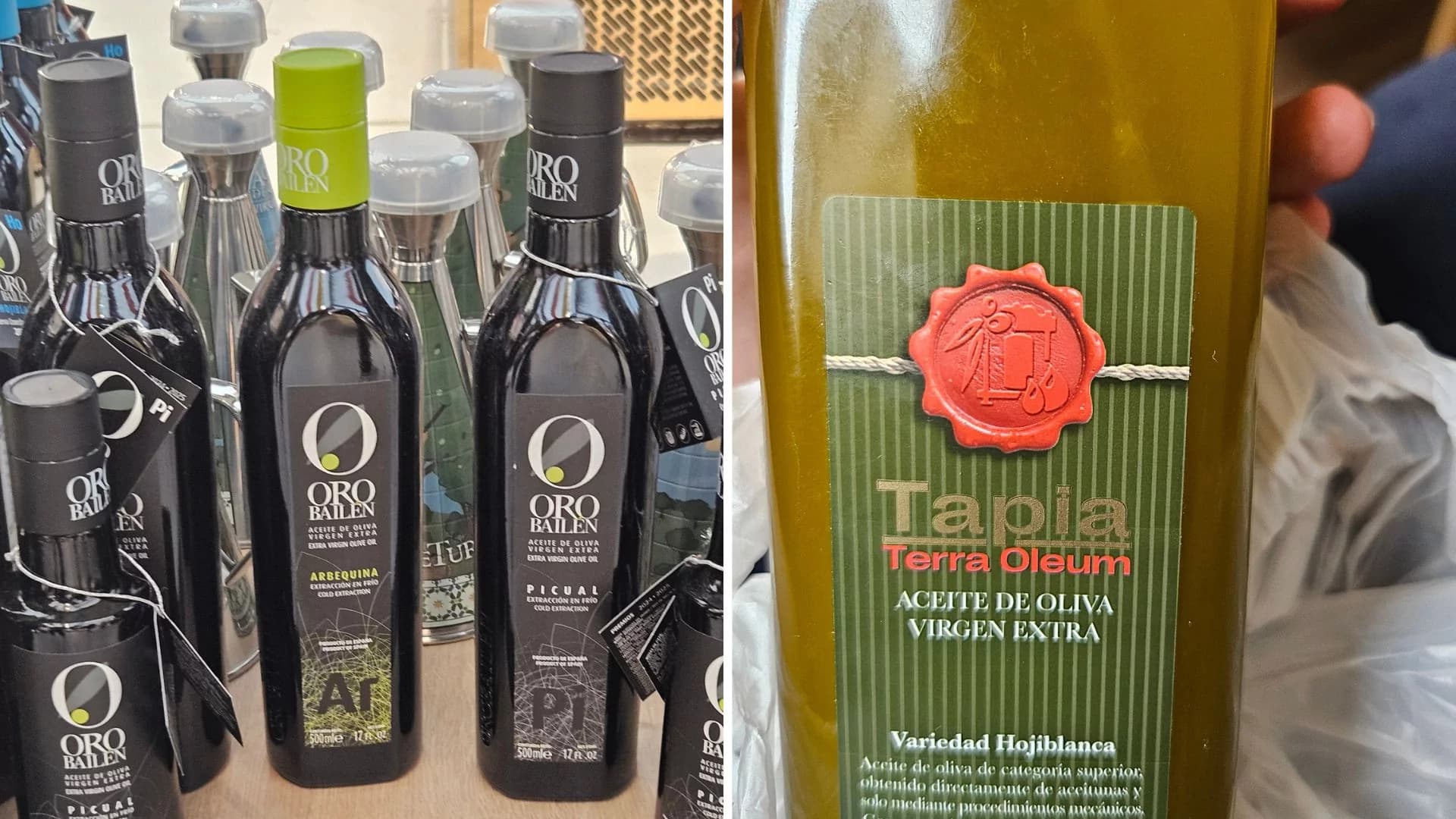
Olive oil
SPORT
Malaga CF
As mentioned, people spend a lot of time on the beach in various activities. You often see Malaga CF kit — the local football club in Segunda, Spain’s second division. Club colours are blue and white; they play at La Rosaleda, capacity around 30,000, with a Qatari owner since 2010. Twelve years ago they reached the Champions League quarter-finals and were a regular top-flight side, but since then they have declined and played in lower leagues in recent years. Another curiosity: they played Sarajevo’s Željezničar in the first round of the UEFA Cup in 2002/03. The match in Sarajevo ended 0–0; at La Rosaleda Malaga won 1–0 and advanced. Želje had earlier been knocked out of Champions League qualifying by Newcastle.
During this stay I did not go to a match because the dates did not suit me, but I liked their shirt and bought a replica on the street as a souvenir. Original shirts, much more expensive, are sold at the official shop or at Hummel, their current sponsor, and can be ordered online.
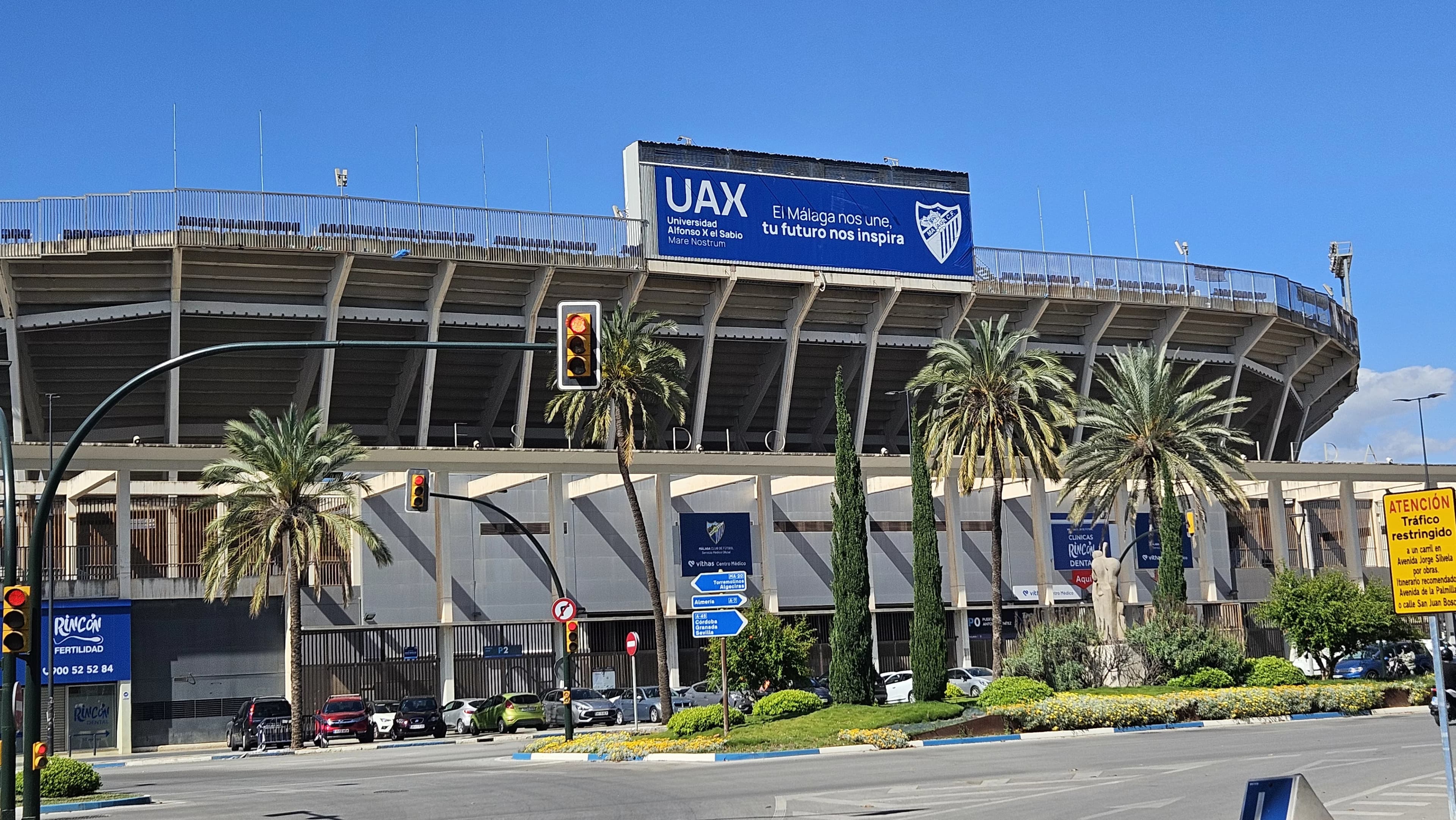
La Rosaleda stadium from outside
Unicaja and the match
Besides football, Malaga has a very successful basketball club Unicaja, named after the bank based in the city and its main sponsor. Unicaja plays in the ACB, Spain’s top league. You see many children in club gear in the streets; many probably train in youth teams. The main colour is green, like the bank logo. They have been Spanish champions once, won the cup three times, and their best EuroLeague result is third place.
The Spanish league is the strongest national league in Europe; I followed it most fifteen years ago when Mirza Teletović played for what was then Tau Ceramica. Even on TV the quality was high, anyone could beat anyone, and arenas were full. That is why I decided to go to a game; the best fit was when Unicaja played Gran Canaria. Another reason was that our national team player Emir Sulejmanović and former international Nihad Đedović currently play for Unicaja. Home games are at the modern Palacio de Deportes José María Martín Carpena, capacity around 11,000, near Guadalhorce nature park and the airport. Besides Unicaja, the arena hosts concerts, Davis Cup tennis and other events. Although the game was moved from Saturday to a weekday (Wednesday), the arena was fairly full with a very pleasant atmosphere. Whole families come; it is loud but supportive without extreme tension. Many bring their own food — sandwich culture, bocadillos, is strong.
This season Unicaja were fighting for a top-eight finish and playoffs; Gran Canaria were fighting to stay up. The game was very interesting. Unicaja led comfortably most of the way and seemed set to win. Near the end they made a few mistakes, the visitors hit a couple of shots and it went to overtime. Gran Canaria did better there and won 100:101. Sulejmanović had a strong game: in 21 minutes 9 points, 5 rebounds, 3 assists and several good plays. The only gripe is two missed free throws — seems a general issue for our internationals. Đedović did not play, probably injury. Unicaja’s best were Perry with 20, Perez 17, Diaz 15. For the visitors Wong, Pelos and Metu stood out with 29, 24 and 17.
The Unicaja game was a nice experience and shows how present sport is in Malaga. People love their clubs, helped by playing at a high level. I am sure the same applies at La Rosaleda when the football club plays.
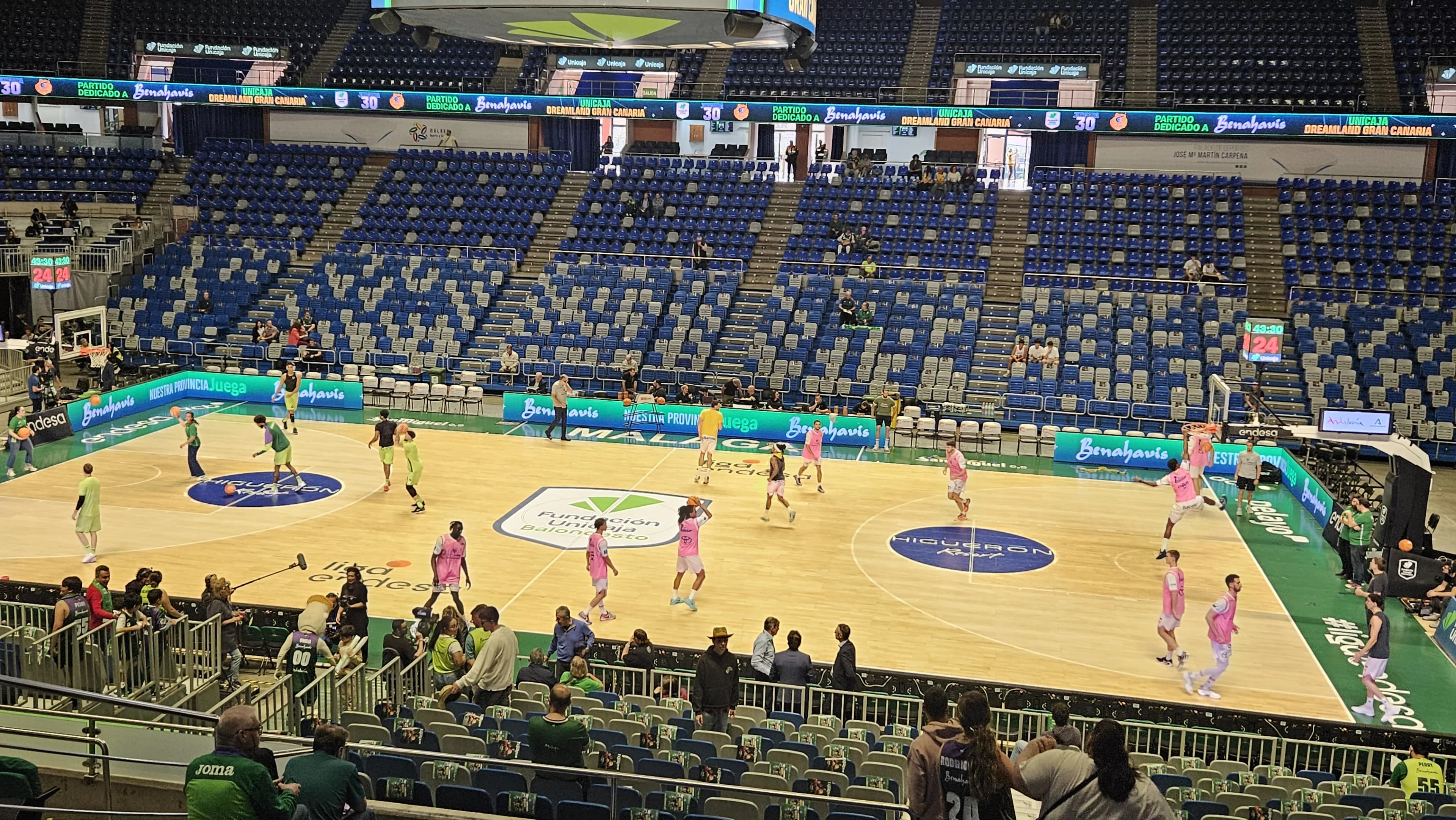
Unicaja — Gran Canaria: warm-up
Video: before Unicaja–Gran Canaria
FRIDAY PRAYER
Mosque in Malaga
On this trip I was on day trips to distant cities on two Fridays; the other two Fridays I was in Malaga and needed to perform Jumuah — the Friday prayer that adult Muslim men must perform in congregation at midday. I prayed at the Andalusia Cultural Centre in Malaga, which is both a mosque and a space for other activities and needs of Muslims in Malaga and the area. The centre is in a very convenient location, about a kilometre north of Maria Zambrano main station and less than two kilometres from the historic centre. The space is huge; according to online information it can hold around 1000 people. It also has a 25-metre minaret. This mosque left a special impression — truly imposing, with beautiful motifs and details reminiscent of Nasrid Cordoba or Granada.
Before Jumuah people gather, perform ablution and voluntary prayers. Midday was around 14:15; the call to prayer for Jumuah was at 14:30. Then comes the imam’s khutbah (sermon), twenty to thirty minutes, entirely in Arabic. With my modest Arabic I gathered that on the first khutbah the imam spoke about attributes of the Merciful mentioned at the end of surah Al-Furqan; on the second he spoke about part of the Prophet Muhammad’s day when he sat with his companions and conveyed many of his counsels from such gatherings. After the khutbah two obligatory rak’ahs are prayed behind the imam in congregation, then people disperse; some stay for extra voluntary prayer. The mosque was full to capacity; many women also attend Jumuah although it is not obligatory for them.
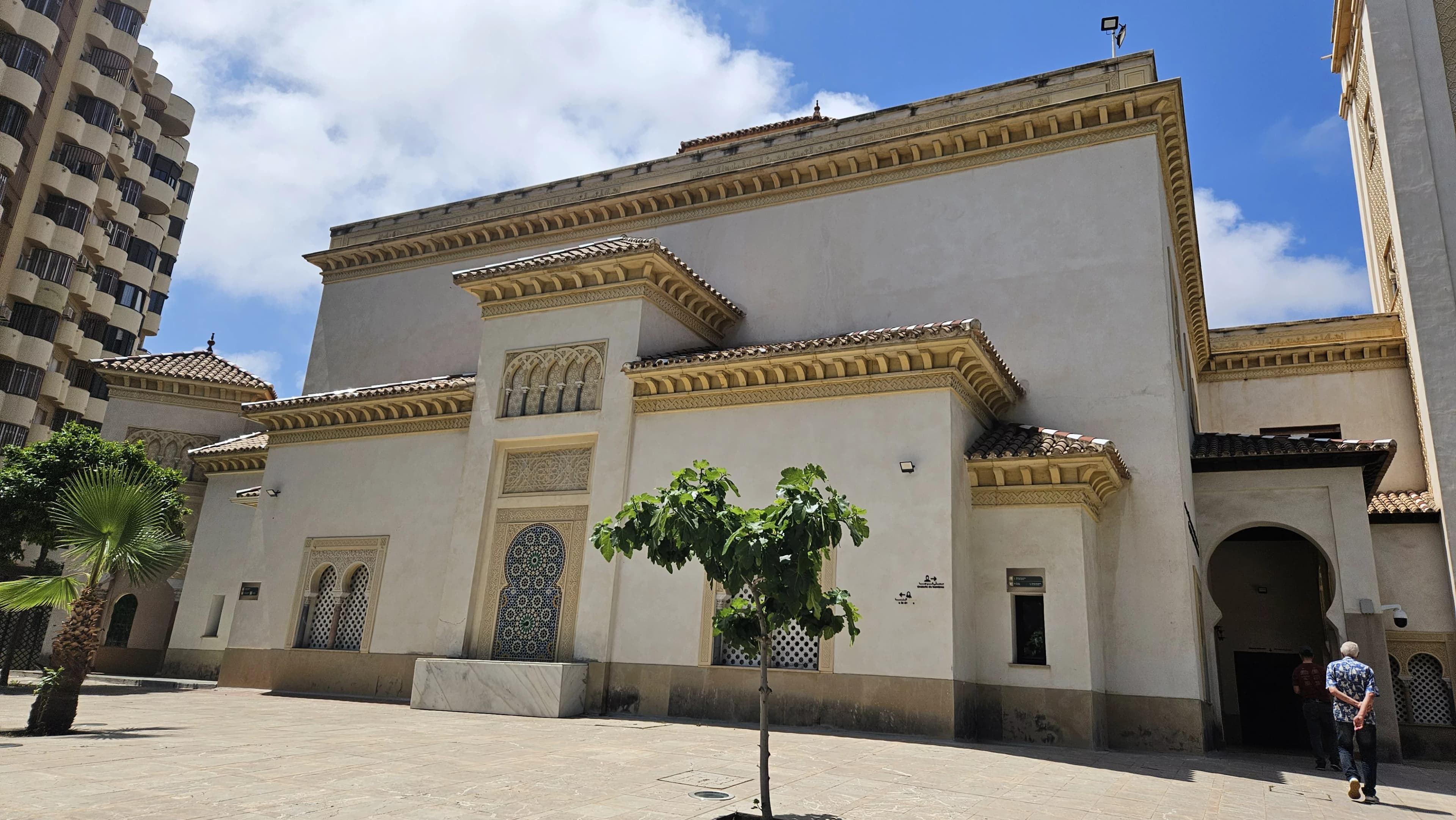
Andalusia Cultural Centre, Malaga
Other mosques in Andalusia
For Muslims, prayer five times a day is obligatory. Because prayer times follow parts of the day, in Spain all prayers occur about an hour to an hour and a half later than in Bosnia. In Malaga we mostly prayed in our rented flat. On day trips we visited other mosques or musallas; when that was awkward we prayed in parks or nature. For that I always carry a pocket prayer mat my uncle brought from Mecca.
Mosques usually open 10–30 minutes before prayer time and close after the prayer. The first mosque where we prayed was Al-Morabito in Cordoba, in the commercial centre in Jardines de la Merced park, 500 metres from El Corte Inglés. We came across it by chance while resting in the park and were pleasantly surprised — it sits in the heart of the park. Compact, with plenty of shade and ablution facilities. Visiting Marbella we stopped at King Abdulaziz Al-Saud Mosque, outside the centre — it reminded me of modern mosques in the Arab world. Spacious, with its own car park; we prayed Dhuhr and Asr there. The same day we prayed Maghrib at the Central Mosque in Fuengirola, a short stop on the way from Marbella to Malaga. We arrived shortly after communal Maghrib and found many people. A large mosque with clean, well-maintained ablution areas. Next we visited Abderrahman Mosque outside Andalusia on the island city Palma de Mallorca in the Balearics. About a kilometre from the centre, between buildings, with a small minaret visible from the street. Within 500 metres there are several bus stops, so it is very accessible. During prayer I heard some commotion; afterwards my wife explained that in the women’s section a teacher was teaching Quran to small children who were restless, so he had to be strict and raise his voice to calm them and restore focus. The next mosque was Fundación Mezquita in Seville, very close to main tourist sites such as the cathedral or Alcázar. Not a classic mosque with a minaret but more a ground-floor business space adapted for Muslims. A large complex has long been planned; they are currently looking for suitable land. The last mosque we visited was the Great Mosque in Granada, in the old quarter Albaicín by the viewpoint Mirador de San Nicolas. Like in Cordoba, we found it by surprise after visiting the viewpoint. It has a beautiful garden that, like the viewpoint, looks towards the Alhambra.
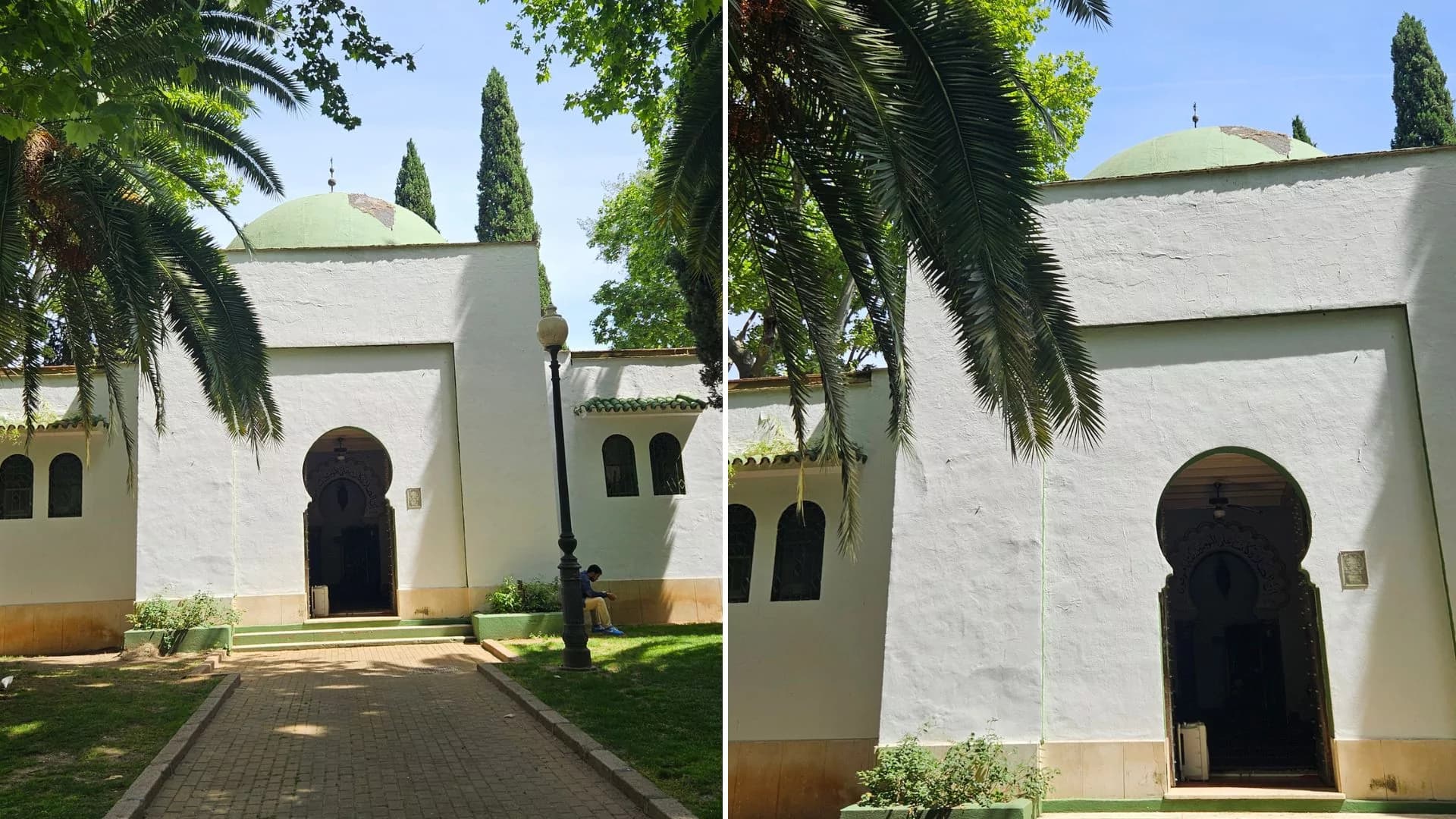
Al-Morabito mosque, Cordoba
Although visiting mosques was not the primary plan — prayer can be performed anywhere clean that is not a graveyard or toilet — we can say we visited almost all the significant mosques in Andalusia, largely because they are well placed relative to main tourist attractions.
Below is a map with the locations of mosques we visited on this trip. Click the blue-yellow icons on the map to open a window with more information.
CYCLING ALONG THE COAST
Visiting Torremolinos and Benalmadena
Torremolinos and Benalmadena are coastal towns on the Mediterranean west of Malaga, in Malaga province in Costa del Sol. You can reach them by bus from Malaga for under 2 euros one way. Because they are close, we combined visiting them with another planned activity: we rented bikes for one day and rode out and back the same day, about 40 km (20 km each way). We left around 10:00; beforehand we had a light breakfast at Atarazanas market — salmon sandwich, or toast with salmon and avocado. We rented from Soho Bike in central Malaga. We chose an Urban bike for city riding and short stretches, planning a relaxed pace with breaks. Other options were a gravel bike with dropped bars and an e-bike. Rental was 19 euros per person for the day until closing at 20:00. No deposit required.
At the start we lingered in the city to find our way, then soon left on a wide pavement along the port past pedestrians; after a few minutes we were on the cycle path. We followed it about 5–6 kilometres to the sports arena, Guadalhorce nature reserve and the river of the same name.
Guadalhorce nature reserve
This was a good chance to see the reserve since we had to pass through anyway to continue towards Torremolinos. We rode in circles a while until we found the entrance because the marked cycle path ends before it. Flat gravel and dirt paths run through the park, ideal for an easy walk or bike ride with views of nature and the Mediterranean coast. We took our first break on a winding wooden bridge over the river, enjoyed the setting and filmed a bit. After leaving the reserve the route passes the airport and briefly through a less pleasant stretch with more traffic, faster roads and industry. In places you ride on the road itself, so we were more careful. Then the route returns to proper paths and promenades along the beach.
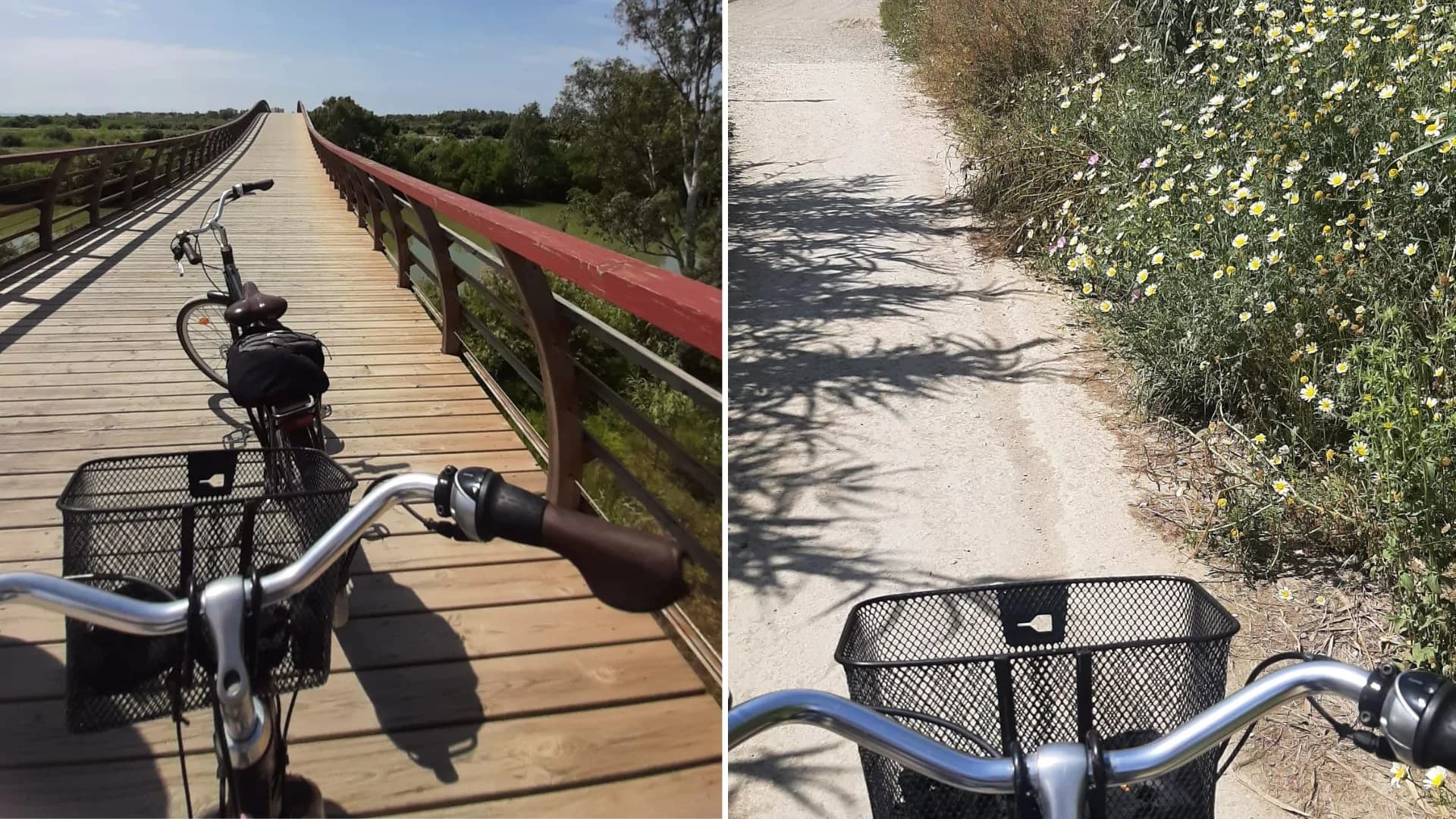
Guadalhorce nature reserve, Malaga
Torremolinos
Once past the airport zone, Torremolinos beaches begin. Until then the weather had been slightly cloudy; in Torremolinos the sun warmed nicely. The town has a beach stretching almost eight kilometres, covered along its length by a cycle path or wide promenade. This is the first and best-known tourist resort on Costa del Sol. We took another break at a beach café with smoothies and rested longer before continuing to nearby Benalmadena. We did not enter the old centre but rode on. Because of the crowds out for a walk, one short stretch was awkward on the bike. Once a boy ran out in front of me; I had to throw the bike aside — no harm done, our only incident.
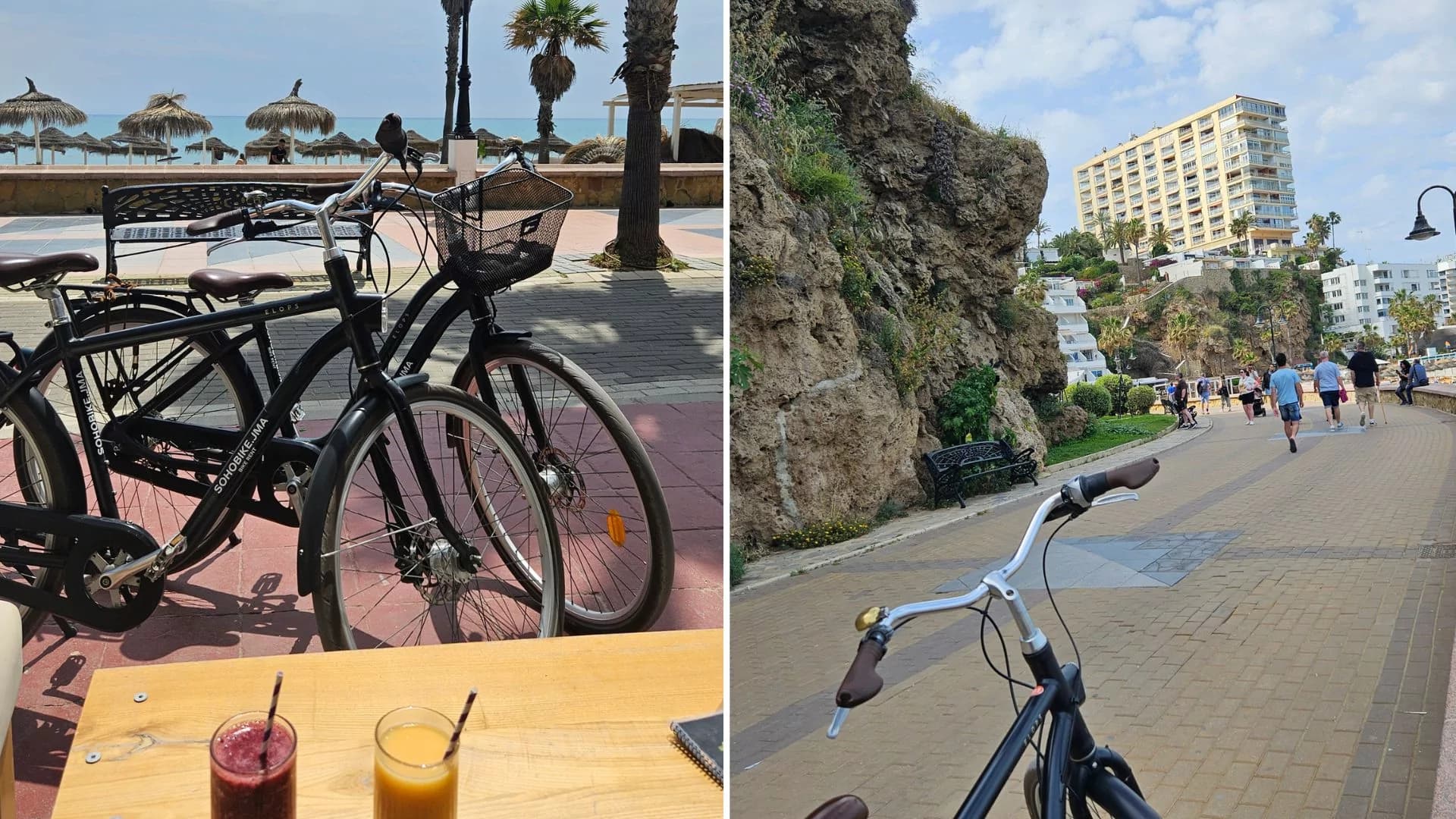
Torremolinos
Benalmadena
After another 15–20 minutes we reached the marina in Benalmadena. There are unusual buildings that look as if they float on the water — built to make the place look more luxurious and attract tourists, reminiscent of Gaudí-style architecture. From the marina we walked towards the centre pushing the bikes. The reason was a gentle uphill, narrow streets and crowds — awkward on the bike. We did one loop through the small town surrounded by tourist apartments. It was fairly empty because we arrived after lunch; Torremolinos had been much busier earlier. We took a longer break in Parque de la Paloma, refreshed and prepared for the return. We had noted two attractions — the cable car to Calamorro mountain and Colomares fortress in another part of town — but had neither energy nor time. This trip was near the end of our Andalusia stay after seeing a lot; we saved strength for the ride back and left those for another time.
After the park break we headed back to Malaga without further stops. A few short breaks because the urban bike grew uncomfortable on a long ride, but it did the job. We returned to the agency around 19:00; I noticed my hands were quite sunburned. I had forgotten sunscreen in the morning; while riding, wind and movement make the sun almost unnoticeable. We had eaten nothing since breakfast, so we ended the day with seafood at a restaurant. A great experience — a full day, especially enjoying the ride along the beach.
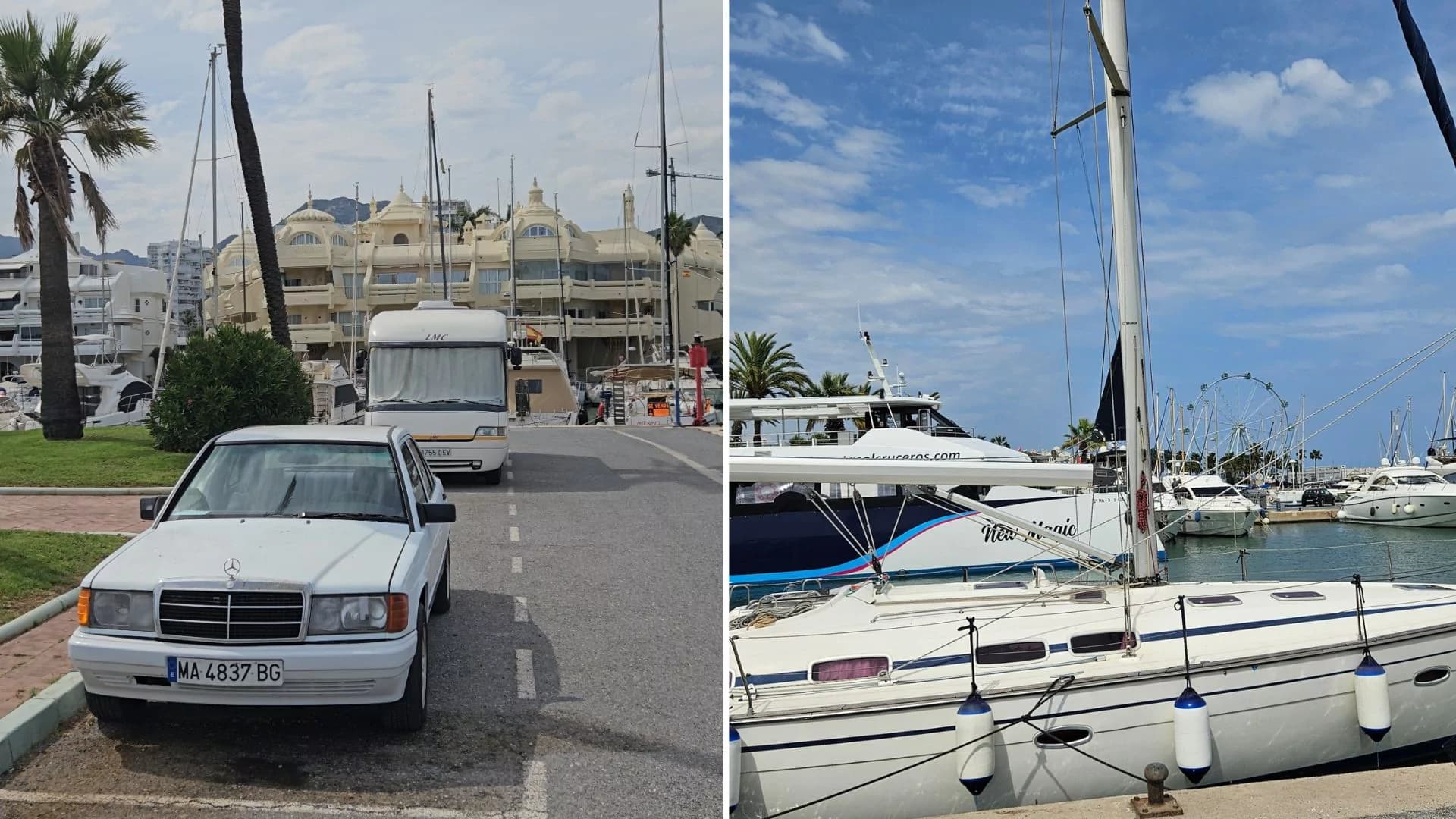
Marina in Benalmadena
DAY-TRIP SUGGESTIONS
As we said at the start, Malaga is extremely well connected to the rest of Andalusia and Spain, so day trips to nearby and farther places are easy. We mostly used Alsa buses, a very reliable operator. We also took Renfe and Ouigo trains several times. From Malaga you can even fly day trips within Spain; for some places renting a car is best. While we were there petrol was around 1.50 euros per litre and diesel about 1.85; prices rose slightly towards the end of our stay. Below are some suggestions for trips from Malaga.
- Seville, Granada, Cordoba — with Malaga, the most significant cities in Andalusia for history and sights. Granada and Cordoba can be done in one day with good planning; Seville needs several visits for a full impression. Train or bus works.
- Ronda, Setenil de las Bodegas, Marbella — a car trip combining canyons, unusual houses and driving along the coast.
- Nerja and Frigiliana — often visited together as one of the best-known day trips from Malaga: Nerja for the Mediterranean coast, beaches and sea viewpoints; Frigiliana for white Andalusian houses, narrow stone streets and calmer hill atmosphere above the coast.
- Caminito del Rey — once considered one of the world’s most dangerous paths, now fully restored for safe tourist use. Easy to reach by train from Malaga; best to book a ticket with a guide.
- Madrid — reachable by fast train in just over three hours.
- Palma de Mallorca — Malaga airport connects well; an easy day trip to the island. Palma is a lovely city for a full day. Ryanair currently offers an early Wednesday flight from Malaga with a late return from Palma; other days exist but not always with same-day return.